


Author | WuBlockchain
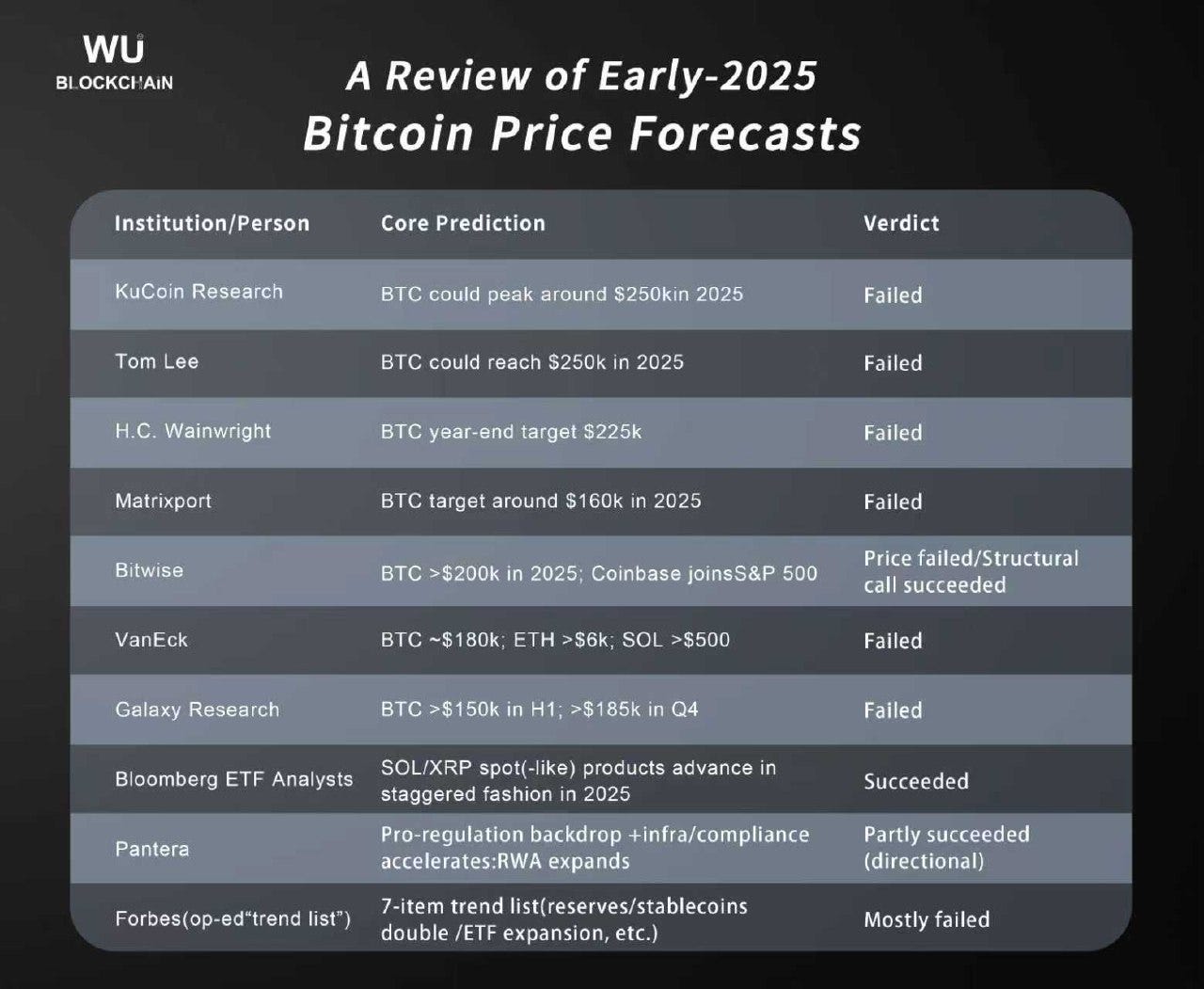
From late 2024 to early 2025, the crypto market was broadly aligned around a common narrative for the next cycle: post-halving momentum, the expansion of ETFs and institutional adoption, and more favorable regulatory expectations were widely seen as the core fuel that would push BTC — and risk assets overall — higher. Against this backdrop, many institutions and well-known figures put forward aggressive annual price targets (especially in the USD 200,000–250,000 range). Others focused more on “industry structure changes,” such as the expansion of compliant product supply, the further mainstreaming of exchanges and crypto companies, and continued growth in sectors like RWAs and stablecoins. Looking back at actual performance in 2025, price-point forecasts generally overestimated both the strength and persistence of the rally, while judgments related to regulation and industry structure proved relatively easier to realize.
KuCoin Research
In its 2025 Crypto Market Outlook, KuCoin Research’s core thesis — based on “historical post-halving performance plus institutional/ETF-driven adoption” — was that BTC could test a peak of around USD 250,000 in 2025. It also projected that total crypto market capitalization (excluding BTC) could reach roughly USD 3.4 trillion by the end of 2025, ushering in a stronger altcoin season. On the regulatory and product front, it expected progress or approval for more crypto ETFs such as Solana and XRP in 2025. In terms of applications and structural trends, it emphasized RWA tokenization, AI agents, and the expansion of stablecoins (projected to exceed USD 400 billion by the end of 2025) as key themes.
In hindsight, the miss was concentrated mainly on “price intensity”: BTC’s intra-year peak was only a bit above USD 126,000, and it retreated to around USD 88,000 by year-end — far from the USD 250,000 target. Partial successes were more evident in “structural and supply-side trends”: 2025 did see progress and actual trading launches of compliant products linked to SOL and XRP (for example, BSOL began trading on 2025–10–28, and XRPC on 2025–11–13), aligning more closely with its view on ETF diffusion and expanded product supply. However, scale targets such as “stablecoins exceeding USD 400 billion by year-end” were closer to being unfulfilled or overly optimistic.
Tom Lee
In January 2025, Tom Lee publicly discussed a potential BTC target of USD 250,000, citing factors such as regulatory tailwinds, market resilience, and improving liquidity conditions. In reality, based on BTC’s actual volatility path in 2025, this target clearly fell short.
H.C. Wainwright
In January 2025, H.C. Wainwright raised its year-end BTC target to USD 225,000. The rationale included historical cycle patterns, expectations of a more favorable regulatory environment, and rising institutional interest. This target also clearly failed to materialize. Similar to Tom Lee and many other “USD 200,000-level” forecasts, the core issue was treating favorable conditions as a linear driver of upside, while underestimating the market’s sensitivity at elevated levels to macro risks and crowded leverage. Once drawdowns were triggered, markets tended to move first toward “risk clearing” rather than continuing to discount narratives into ever-higher forward prices.
Matrixport
In December 2024, Matrixport characterized 2025 as a “breakout year” for BTC and set a target of USD 160,000 — lower than the USD 200,000–250,000 camp. Compared with targets of USD 225,000 or USD 250,000, this threshold was more modest and arguably more in line with a reasonable upper bound based on improved sentiment and liquidity. Even so, relative to 2025’s final performance, it still did not materialize.
Bitwise
In its December 2024 “Top 10 Predictions for 2025,” Bitwise opened with an aggressive call: BTC, ETH, and SOL would all reach new all-time highs, with BTC trading above USD 200,000 in 2025. At the same time, it made a series of more “industry-structure-focused” bets — such as Coinbase entering the S&P 500, significant expansion in stablecoins and tokenized assets, and a reopening of the crypto IPO market.
In terms of results, the “price-point” forecast clearly failed: although BTC did reach an intra-year peak in October 2025, it ended the year well below that high, let alone USD 200,000. On the other hand, the “mainstreaming” elements were closer to reality: Coinbase was officially included in the S&P 500 in May 2025, and the IPO/listing market did see notable progress during the year.
VanEck
VanEck’s “Top 10 Predictions for 2025” not only set price targets but also outlined a very specific cycle path. It expected the bull market to reach a mid-cycle peak in Q1, with cycle-top targets of roughly USD 180,000 for BTC, over USD 6,000 for ETH, above USD 500 for SOL, and above USD 10 for SUI. It then anticipated a potential 30% pullback in BTC and up to a 60% drawdown in altcoins, followed by a recovery in momentum toward year-end.
Compared with actual 2025 performance, the general framework of “large drawdowns and high volatility” was not unreasonable, but the key hard price levels (180k / 6k / 500 / 10) were broadly not realized.
Galaxy Research
In its late-2024 outlook for 2025, Galaxy Research articulated BTC’s core logic very directly: adoption by institutions, corporations, and even nation-states would push BTC above USD 150,000 in the first half of the year and test or exceed USD 185,000 in Q4. It also offered a broader set of industry forecasts, including stablecoin growth, DeFi expansion, and rising institutional participation.
In practice, while BTC did experience notable upside phases in 2025, it never came close to the USD 150,000 or USD 185,000 targets. One likely reason is that adoption is a “slow variable”: it can shift long-term boundary conditions but is often insufficient to offset “fast variables” such as macro shocks, crowded positioning, and leverage-driven liquidations. When sharp drawdowns occurred during the year, markets tended to price in risk contraction and deleveraging first, rather than continuing to discount adoption narratives into higher long-term extremes.
Bloomberg
At the end of 2024, Bloomberg ETF analysts (such as Eric Balchunas) highlighted the “approval timeline for altcoin spot ETFs” as a key variable for 2025. They argued that spot ETFs for Solana and XRP were likely to enter a realistic pathway in 2025, while also clearly noting that approvals would not arrive “all at once,” but rather through a lengthened regulatory process with staggered rollouts.
In hindsight, this assessment can largely be considered accurate in both direction and timing: on October 28, 2025, Bitwise’s Solana Staking ETF (BSOL) began trading; subsequently, on November 13, 2025, the Canary XRP ETF (XRPC) started trading on Nasdaq. The two launches indeed occurred sequentially rather than simultaneously.
Pantera
Pantera’s 2025 crypto outlook centered on “an improving policy environment plus accelerated compliance and infrastructure development across the industry,” with particular emphasis on the continued expansion of RWAs and real-asset tokenization as structural trends.
Looking back, the successes were mainly directional: policy and regulatory tailwinds, along with structural industry progress, did clearly materialize during the year. The shortcomings were primarily in “price intensity”: Pantera itself acknowledged that 2025’s price performance fell short of many expectations, as the market experienced stronger volatility and drawdowns after rallies.
Forbes
Some Forbes columns and opinion pieces early in the year offered “Seven Major Crypto Trends for 2025”-style forecasts, including ideas such as “major economies establishing strategic Bitcoin reserves,” “stablecoin market capitalization doubling to USD 400 billion,” “rapid growth of BTC DeFi via L2s,” and “crypto ETFs expanding into Ethereum staking and Solana.”
In retrospect, some directional elements of these “trend lists” came closer to fruition (for example, discussions around ETF product lines and regulatory improvements did see progress during the year). However, assuming that multiple aggressive variables would all unfold smoothly within a single year proved overly optimistic — especially targets such as “USD 8 trillion total market cap,” “tech giants following Tesla in adding BTC to their balance sheets,” or “stablecoins doubling to USD 400 billion by year-end.” The end result was that a few points were partially validated, while most fell short of expectations.
Conclusion
Overall, the wins and losses of these early-2025 forecasts are not hard to explain. The more a forecast relied on a single price point — and the more extreme that target (USD 200,000–250,000) — the more likely it was to fail. Conversely, forecasts focused on regulatory processes, product supply, and industry-structure changes were more likely to be partially or directionally correct. The 2025 market followed a high-volatility path of “new highs — drawdowns — repricing”: macro risks and leverage-driven deleveraging repeatedly interrupted trends, meaning that “being right in logic” did not necessarily translate into “hitting a year-end price target.” By contrast, supply-side changes such as the launch of compliant products and increased participation by mainstream institutions were more verifiable — and therefore held up more robustly in hindsight.
Follow us
Twitter: https://twitter.com/WuBlockchain
Telegram: https://t.me/wublockchainenglish