
ETHDenver 2026 Observations: Side Events Halved, AI Explosion, Builders Searching for New Paradigms

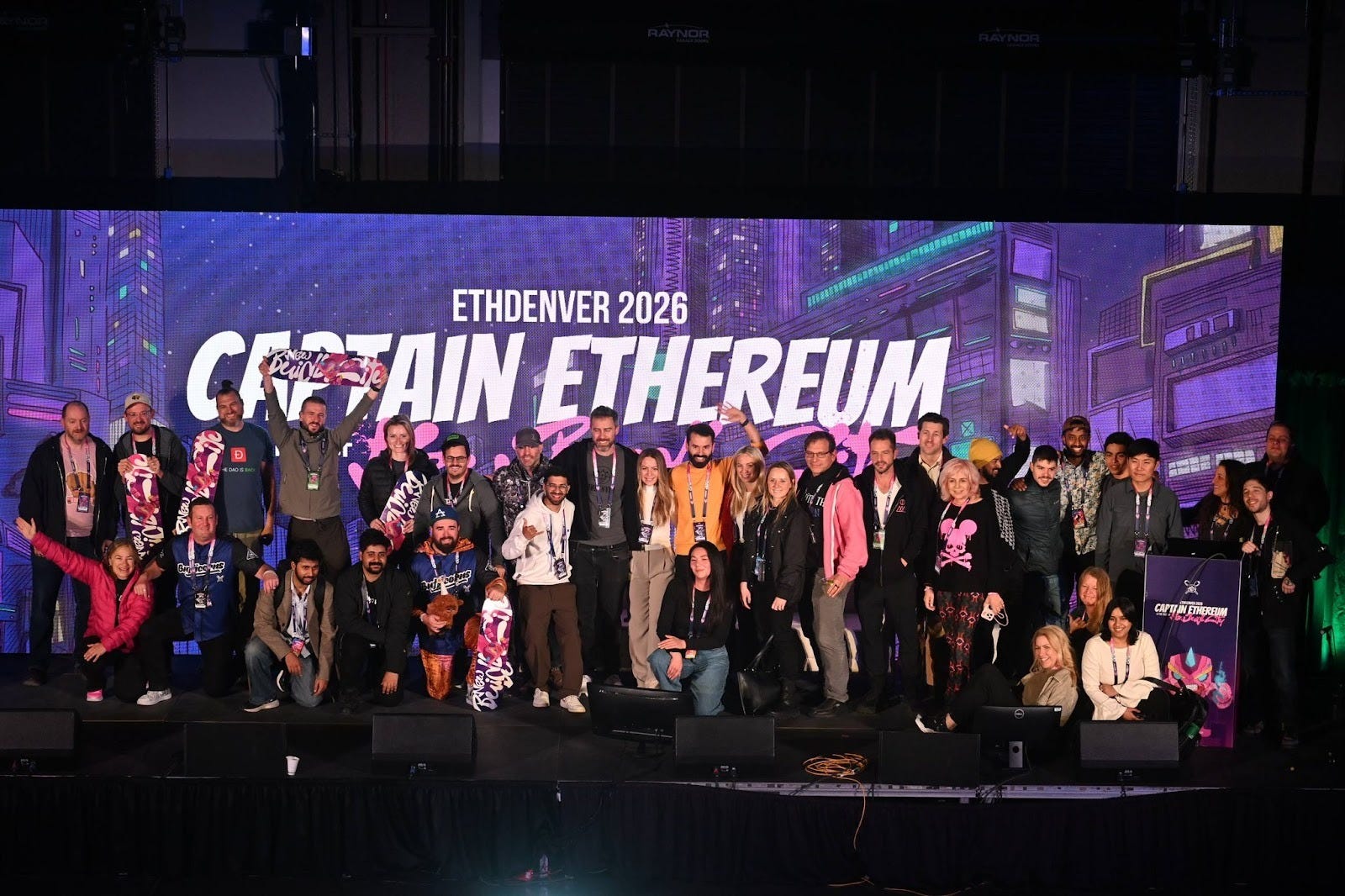
Author | kyle WuBlockchain
Editor | Mao Di WuBlockchain
Side Events Halved
Let’s start with the most visible signal: side events shrank sharply this year. Based on Luma listings during the ETHDenver window (Feb 18–21, 2026), the number of side events fell from 668 in 2025 to ~215 in 2026, a ~68% decline.
There are several reasons behind this. One factor is the industry cycle itself; another is that the conference timing is close to the Lunar New Year, which isn’t ideal for many Asian project teams and attendees. In addition, some external gatherings also diverted attention — for example, the WLFI Forum at Mar-a-Lago drew in a number of OGs and core builders.
As a result, while ETHDenver still gathered a meaningful North American Web3 crowd, the number of people traveling from outside the U.S. felt noticeably lower — reducing the conference’s broader influence.
From the activity level of various ecosystems, you can also sense the industry is entering a phase that values efficiency and cost-saving.
Monad and X Layer had a relatively strong presence — Monad hosted three events, and X Layer sponsored the main stage (though the team only attended the first day of the expo). Aptos and Sui also had certain exposure; Solana hosted only one event, small in scale but with good quality. Overall, many public chain ecosystems no longer pursued the old playbook of maximizing visibility through a high volume of events. Instead, they kept only a few side events — often one or two symbolic appearances — prioritizing cost-effectiveness over scale.
AI Everywhere
One of the biggest changes this time is that AI is almost everywhere.
In addition to the main stage, ETHDenver split the main venue into five stages — ETHERSpace (applications & user ownership), Devtopia (infrastructure & developer tools), New France Village (finance/compliance/institutional), Futurllama (AI/DePIN and frontier trends), and Prosperia (privacy, public goods, and community). After three days of walking around, Futurllama had the largest crowds.
The main venue also featured the Claws Out Summit for the recently popular “lobster” OpenClaw, as well as small pitch sessions for AI project founders. Outside the venue, the AI-themed Open AGI Summit hosted by Sentient was even larger and more crowded than some main-venue areas. The vibe of this ETHDenver no longer resembles a traditional crypto industry conference, but more a hybrid AI × Crypto expo.
Even the types of exhibiting projects changed. Seeing robots and robotic arms on the expo floor created an illusion of “Did I walk into CES?” Projects like PrismaX and Gensyn, focusing on embodied intelligence, had dedicated booths. Furthermore, many projects still carried the Web3 label, but their core narratives were no longer about public chains, DeFi, or wallet infrastructure — instead, they leaned toward agents, chatbots, and other application-layer AI products.
A strategy manager from an exchange said that during this conference, he wasn’t focusing on mature projects but on very early ones — even those with only an initial outline. Regarding AI + Crypto, what he focused on wasn’t immediate revenue, but whether the combination of AI and Crypto would generate new production relationships, new distribution methods, new workflows, and new on-chain collaboration mechanisms.
He also shared an internal strategic perspective from his company’s leadership: everyone already assumes AI will bring huge productivity improvements, but within the Web3 field, the real opportunity isn’t so-called large models, but whether AI technology can be embedded inside the exchange to enhance the current product experience. They are currently developing an in-exchange LLM that provides trading recommendations based on real-time market news and executes related trades directly within the chat box.
ETHDenver Remains Builder-Oriented
Although AI became the hottest topic, one thing unchanged about ETHDenver is that it remains one of the most builder-oriented crypto conferences.
This is reflected in the agenda. On the final day, aside from the closing ceremony, all expo time was given to the hackathon and Builder Workshop. Side events hosted by public chains like Base were also centered around developers.
One notable point is that Base showcased a small product called Braindate during the conference. Base carved out a dedicated area for social chats, but unlike traditional conversation zones, participants could join interesting sessions on Braindate or create their own to gather like-minded people.
This builder energy was clearly present onsite: rather than discussing market trends, attendees at ETHDenver were more often asking, “What are you building recently?” Student builders especially cared about “Can this be built?” and “Is this product interesting?” rather than short-term market fluctuations. As a result, although ETHDenver shrank in overall scale, it didn’t become a purely narrative-driven, non-product conference. At least here, true builders remain at the core.
The best reflection of this spirit is still the BUIDLathon hackathon, and this year’s BUIDLathon had one significant change: the overall competition design became more front-loaded.
According to participants, BUIDLathon added an online hacking stage. Specific topics were announced one week in advance, rather than the traditional “start building when you arrive onsite.”
This is an interesting innovation. It aligns with how many builders now work in reality and makes it easier to increase project completion. But at the same time, in-person interaction time became shorter — from eight days last year to four days this year — meaning much preparation must be done in advance. Offline is no longer the starting point of building, but more a period for final concentrated wrap-up.
Changes in competition format may simply reflect organizer preferences, but changes in the prize pool harshly reveal the industry’s current cycle.
Multiple participants complained that both the number of sponsors and their budgets shrank significantly. Last year’s prize pool was USD 1.03 million; this year it shrank to USD 132,000. Sponsor budgets became more concentrated and skewed toward AI — the direction they care most about.
One participant mentioned that one of the winning hackathon projects featured an “AI girlfriend.” Users could tip the AI girlfriend with crypto; through frequent tipping interactions, the system formed a behavioral incentive mechanism that deepened the relationship between the two. Although this tipping mechanism sounds like a meme, the project’s success reflects a point: judges no longer view AI + Crypto only through strong Web3 lenses like wallets or settlement. They want to see projects imagining usage scenarios closer to ordinary mass-market users.
I also interviewed Justin, a participant who won the third-place Base sponsorship prize. His project is an open protocol for AI agent advertising monetization.
The judgment behind this project is: many AI products that are free and open to the public in the future may need ads rather than subscriptions to sustain monetization. Advertisers pay for promotional tasks; AI agents distribute recommendations based on user context, drive conversion, and earn revenue after completing tasks.
The biggest challenge, however, is proving that the AI truly completed the advertising task.
Justin’s solution introduces on-chain validators to verify advertising results. In this hackathon demo, he mainly verified behaviors such as on-chain purchases — only when relevant deliverables were confirmed as real by validators would the protocol trigger settlement, and the advertiser’s budget would actually be paid to the agent. In this sense, this project is not merely “AI taking ads,” but an attempt to build verification and settlement infrastructure for future AI-native advertising markets.
Another notable point of this hackathon: the participant base was very diverse.
There were university students, senior builders, deeply experienced industry veterans, and creators with very fresh, playful ideas. Besides AI and DeFi, there were some interesting GameFi projects.
ETH Denver’s hackathon has not turned into a closed-loop crypto nerd fest; you could feel many newcomers entering, and they weren’t burdened by the need to build traditional crypto-use-case projects. Instead, they naturally integrated AI, gaming, advertising, social, and other scenarios with on-chain technology.
A Somewhat Improvised Judging Process
Of course, this year’s hackathon was far from perfect — the judging process felt somewhat “amateurish.”
Participants reported that judging was divided into main track and sponsor track. The main track was relatively clear: queue at 9 a.m., pitch to 2–3 judges, with the whole pitch and demo process being not too stressful. But the problem is that the presentation time is only five minutes, meaning judges naturally favor teams that can explain their project and show the demo clearly in a very short time. Under tight time limits, strong humor and memorable points are often more important than technical polish; even bugs don’t prevent winning.
After completing the main track, teams must proceed to the sponsor track and pitch again to sponsors like Base. This stage was more chaotic, with unclear queueing order and greater demands on onsite judgment and execution.
Prediction Markets
Aside from AI, another topic worth mentioning separately was prediction markets.
At Frontier Markets hosted by Monad, a few discussion points from speakers left a strong impression. First, they believe the biggest barrier for prediction markets remains liquidity. Second, because every market has an expiry time, liquidity constantly migrates and is hard to retain long-term like in perpetual futures. Third, how to attract liquidity providers to long-tail markets is still a difficult problem.
Meanwhile, prediction markets differ clearly from traditional trading. Traditional trading exhibits gradual volatility, but prediction markets can suddenly go to zero at a certain moment, making leverage design, market-making strategies, and risk management more complex, and causing many large traditional market makers to hesitate.
However, prediction markets also have unique characteristics: many popular markets naturally attract retail-dominated liquidity providers. In other words, the key to this track may not be “building another prediction platform,” but who can continually create markets attractive enough to draw retail participation, and reorganize liquidity and improve user experience around those markets.
Crypto’s Resilience
If I were to summarize this year’s ETHDenver, I would say: it reflects the industry’s state during a bear market and transitional phase. This is not a period of clear narratives where everyone quickly chases trending themes. There is less excitement, less crypto frenzy, and less of the so-called “beauty of economic upcycles.”
Yet at the same time, there are still builders seriously exploring, investors looking at very early but promising directions, and projects that — though imperfect and buggy — are beginning to reveal viable business models and outlines for the next stage of the crypto industry.
Follow us
Twitter: https://twitter.com/WuBlockchain
Telegram: https://t.me/wublockchainenglish