

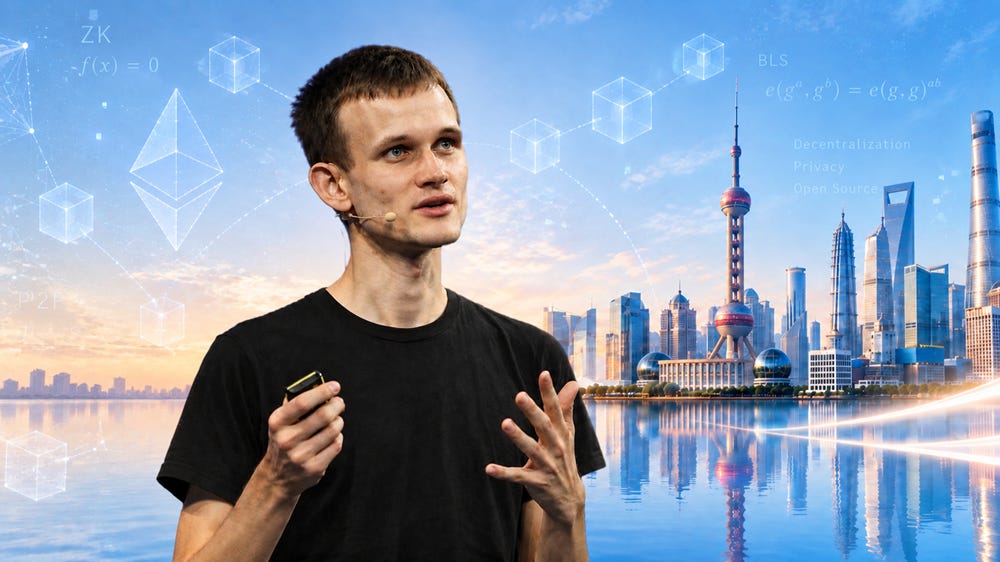
This episode features a public speech by Ethereum co-founder Vitalik Buterin at the 12th Global Blockchain Summit in Shanghai. Vitalik reviews how blockchain technology has evolved over the past 15 years, arguing that the industry is moving beyond blockchain alone toward a broader technological stack combining blockchains with zero-knowledge proofs, programmable cryptography, and other advanced tools. As data analytics and AI become increasingly powerful, the privacy assumptions of early public blockchains are no longer sufficient, creating a greater need for new cryptographic approaches to privacy, scalability, and security.
Vitalik highlights technologies including SNARKs, STARKs, fully homomorphic encryption (FHE), and formal verification. He argues that zero-knowledge proofs are moving from long-term roadmaps into real protocols, while programmable cryptography could expand blockchain systems from determining “who can send what” to determining “who can see what.” In this vision, blockchain will increasingly become a broader network encompassing L1s, L2s, off-chain computation, transaction pools, block building, and other components.
He also argues that AI can accelerate the development, verification, and understanding of complex cryptographic systems. As zero-knowledge proofs become more efficient and technologies such as formal verification and quantum-safe cryptography advance, developers may gain new ways to build decentralized applications with stronger privacy, scalability, and security guarantees.
The audio transcription is done by GPT and may contain errors. Please listen to the complete podcast:
YouTube:
Spotify:
The full text of the speech is as follows:
Vitalik Buterin: The topic I wanted to talk about today is somewhat of a big-picture topic. We have been talking about blockchains, crypto, and cryptocurrency for more than 15 years now. Shanghai blockchain events have been happening for more than 10 years. Bitcoin was created in 2009.
On the surface, the tools and technologies that we’re building seem like they are still similar. But actually, over the last 15 years, there have been a huge number of differences, and I think these differences matter. As a user, the kinds of properties that you get and the kinds of costs that you have to pay are actually very different from what we might have thought 10 or 15 years ago. Even how we think about the goals that we’re trying to accomplish is changing very significantly.
Fifteen years ago, blockchains were the primary tool that we had. Bitcoin combined blockchains, signatures, and proof of work. Ethereum also added smart contracts and switched to proof of stake in 2022. These were the tools that we were working with.
The properties that you get from using a blockchain are, first of all, that blockchains are open and free for anyone to participate in. They are global, reliable, secure, and neutral. There is no centralized actor that can interfere with them, interfere with your application, stop it, or cause it to give a wrong answer.
But public blockchains are also public. Zooko, who created Zcash, likes to use this phrase: “Public blockchains are like Twitter for your bank account.” Satoshi’s white paper in 2009 had a very basic answer to these questions: every individual’s name is not directly attached to their transactions, and that was considered a fairly strong form of privacy. That was maybe an okay answer then, but now we have extremely powerful data analysis and extremely powerful AI. That answer is obviously not sufficient anymore.
At the same time, people want to do more things with blockchains. People want to do things that are more performant, and people are not just interested in payments. Even the payments that we want have stronger and more powerful properties. So we really want to go further, and I think in many ways we need to go further.
Probably the biggest change in technology that we’ve had over the last 10 years is the rise of zero-knowledge proofs. This includes SNARKs, and the quantum-safe version of a SNARK is called a STARK.
What these objects do is allow you to verify a computation. One person runs the computation, and then they generate a proof. Everyone else verifies that computation in such a way that the process of verification is much more efficient. At the same time, it doesn’t even need to reveal all of the information that went into the computation.
A core piece of the technology behind blockchains has to do with this question of verification. We want a system that everyone participates in, where everyone has the assurance that what is happening is following the rules. The original technique is that everyone has to re-execute everything directly. So you sacrifice scalability, and you sacrifice privacy.
SNARKs and STARKs change both of these things. This is a topic that I’ve been talking about for more than 10 years now, but every single year it is coming closer to being a reality.
I think the big change this year is that all of the plans to move Ethereum over to using all of this technology are no longer part of the far-future roadmap. They are now EIPs.
EIP-8288, which we are hoping will get into H-Star, the fork maybe happening two years from now — maybe, possibly with AI, even sooner — is one of those examples. There is also the Straw Map at strawmap.org. Everything inside it after the next two forks is using STARKs everywhere. So this is a big change.
There are also other, more powerful technologies that I think are on the horizon. Fully homomorphic encryption, or FHE, is something many people are using. There is also obfuscation, or iO. For a long time, people thought this was very far in the future, but it is looking like some versions of it might become more viable on a much faster timeframe than many people thought.
We have more powerful technologies, and these technologies give us a lot of things. One example is that you can have blockchains with parallelization, where the parallelization starts even before transactions get included into the block.
FOCIL is an EIP going into H-Star. It’s the first instance of multi-participant block building happening in Ethereum. Blocks are not just created by one participant. There are 16 inclusion-list creators and then one final builder at the end. The goal is to give stronger guarantees that if you send a transaction, that transaction will get included into the next slot. There isn’t one actor that has the ability to delay it.
Then, aside from FOCIL, there is also EIP-8288. EIP-8288 basically says that you have these very large proofs, these very big and expensive objects. We don’t actually need to put them all into the block directly.
Instead, we can have this big parallel process that verifies all of these proofs off-chain. It’s happening in the mempool, in the space between when you send a transaction and when the transaction gets on-chain. In that space, it replaces all of these objects with just one single proof that verifies that they all exist.
There are a lot of these changes in the technology, but I think the important thing about these changes is that they allow us to really change our mindset about what the goals of this kind of system are.
First of all, one big question is: what are we protecting? Bitcoin said we’re protecting one digital asset, which is Bitcoin, the currency. Ethereum says you can issue your own digital assets, and we can protect those too.
With modern cryptography, we’re protecting digital assets and information. In Bitcoin and Ethereum, the cryptography and the code outputted the answer to one question: who can send what? Which asset belongs to whom? Who can send which asset at what time?
Now we’re entering this era of programmable cryptography, where the code decides who can see what. Who is allowed to see what pieces of information? Not just who can send, but who can see. This is something that is becoming programmable.
Where is computation happening? Fifteen years ago, a blockchain was just a blockchain. Over the next five years — and to a large extent this is already happening — we are moving from this view of just having a blockchain to this view of having a whole pipeline, a big cryptographic network.
You have an entire pipeline where a user does a lot of computation locally. A large amount of work happens before anything even leaves the user’s device. Then the transaction passes through a mempool. There are multiple types of mempools, and they have different privacy properties. Then it gets aggregated. There are multiple different kinds of participants in block building, and then it makes it on-chain.
Then there is the mechanism. In Bitcoin, the same transactions were being reprocessed by every node. In Ethereum, one proof can be verified many times.
And finally, what do we sacrifice? I think Bitcoin and Ethereum massively sacrificed scalability, and also latency. A centralized system can offer latency of 100 milliseconds sometimes, or 300 milliseconds if it’s global. Bitcoin is about 600 seconds of latency, about 10 minutes. Ethereum is currently 12 seconds for a block and about 16 minutes for finality.
But in the future, even Ethereum’s latency is currently expected to go down to four to eight seconds for a block and eight to 32 seconds for finality.
For scalability, this is the big change: blockchain architecture will no longer always require such a large sacrifice in scalability. It will sacrifice not scalability, but scalable generality.
It will sacrifice the ability to have extremely scalable computation if you do not give the system any kind of limits or guarantees about what the computation is doing. If you have computation and you can package it into pieces that can be executed separately, verified separately, and run before anything even makes it onto the chain, then very extreme scalability actually becomes possible.
If you think of the blockchain as this entire system that includes the L1, L2s, and the mempool, then mempools, L2s, and all of these systems become this very complex intermediary layer where you or your agents can figure out what parts of it to go through. Huge amounts of scalability can happen inside of there.
Before, we were talking about a ledger. Now we are talking about cryptographically secure computation. We’re talking about taking computation and really creating the cryptographic world computer — creating this system where transactions pass through these cryptographic scalability mechanisms.
Eventually, you do still have a chain, but the role of the chain becomes minimized. The chain does not handle everything. The amount of business logic that actually needs to be processed by every node in series becomes much smaller, because everything else can be done outside.
All of these changes are actually only possible because of AI. I think we have to give AI a large amount of credit for making all of this possible.
My slides not being ugly is also only possible because of AI. Qwen helped make them much more beautiful, so thank you for that.
Basically, every part of the workflow is becoming accelerated by AI. Before AI, we had zero-knowledge proofs, but only fairly simple cryptographic applications were possible. One of the reasons is that if the number of lines of code got above maybe a hundred, maybe a thousand, it became almost certain that there would be a bug inside of it.
With AI, we can use formal verification. We can use different kinds of redundant tests, specifications, and analysis, and we can make much larger and more complicated things safe.
Post-AI, we can put everything that we do inside of cryptography. The algorithms that we used also had very high overhead. Now overhead of 100x or even lower is often possible. For ZK-SNARKs, we already have less than 10x overhead for AI inference. We have less than 10x overhead for some types of hashing. With FHE, I think it’s about 250x, but it’s actually very quickly decreasing.
Verifying all of this used to be manual. Now we have formal verification.
Another major practical bottleneck — and I think this was one of the big causes of L2s not being as effective as they could have been so far — is that there was a limit to how much you could secure them. You needed redundancy, you needed multiple proof systems, and you needed security councils.
The new technique is formal verification. If needed, you can even have multiple specifications and one implementation. You can have different people, different agents, and different teams with different ways of expressing what the work being done is. Then you automatically, mathematically prove that they are all saying the same thing.
If they end up saying different things, then you have a much smaller base that everyone can look at to better understand which side is correct.
There is a huge amount of progress happening in the Ethereum world, both at the protocol level and in applications. I encourage people to go to the roadmap and check out the Ethereum protocol.
If you look at it, you notice that every single hard fork after H-Star — so every single hard fork that’s after about one year from now — is going to involve very advanced cryptographic features: putting everything inside of STARKs, putting everything inside virtual machines, aggregating STARKs, formally verifying everything, and using quantum-safe signature algorithms.
All of these things together are turning Ethereum from being just a blockchain into this much bigger network with different layers in it.
One of the benefits of AI is that it doesn’t just help us build all of these things more quickly and build all of these things more safely — if, of course, safety is something that we actually choose to care about, which in Ethereum we do. AI also makes it easier for anyone here to understand all of these things.
If anyone is a developer or a researcher, I would highly encourage you to try to understand different parts of what is being built: understand the different pieces, understand what properties the different pieces have, and figure out if there is any particular piece of this that you want to contribute to.
Contributing to this kind of frontier technology and ecosystem is rapidly becoming more possible and more accessible to anyone who is willing to learn, willing to think, and willing to put energy into this and help research and build. There are even open competitions happening for improving and formally verifying improvements to a lot of algorithms.
This is also a good time to really rethink applications that we have been working on and build new applications.
Many of the applications that were built on Ethereum five years ago, 10 years ago, or 15 years ago were not built with the mindset that these newer kinds of technologies were possible — that privacy can be programmable, or that the security of even a complex piece of code is something that can be guaranteed. Now these things have become possible.
So I encourage people to go back into developing and building applications that combine Ethereum, other decentralized networks, and other things in the real world.
Follow us
Twitter: https://twitter.com/WuBlockchain
Telegram: https://t.me/wublockchainenglish