


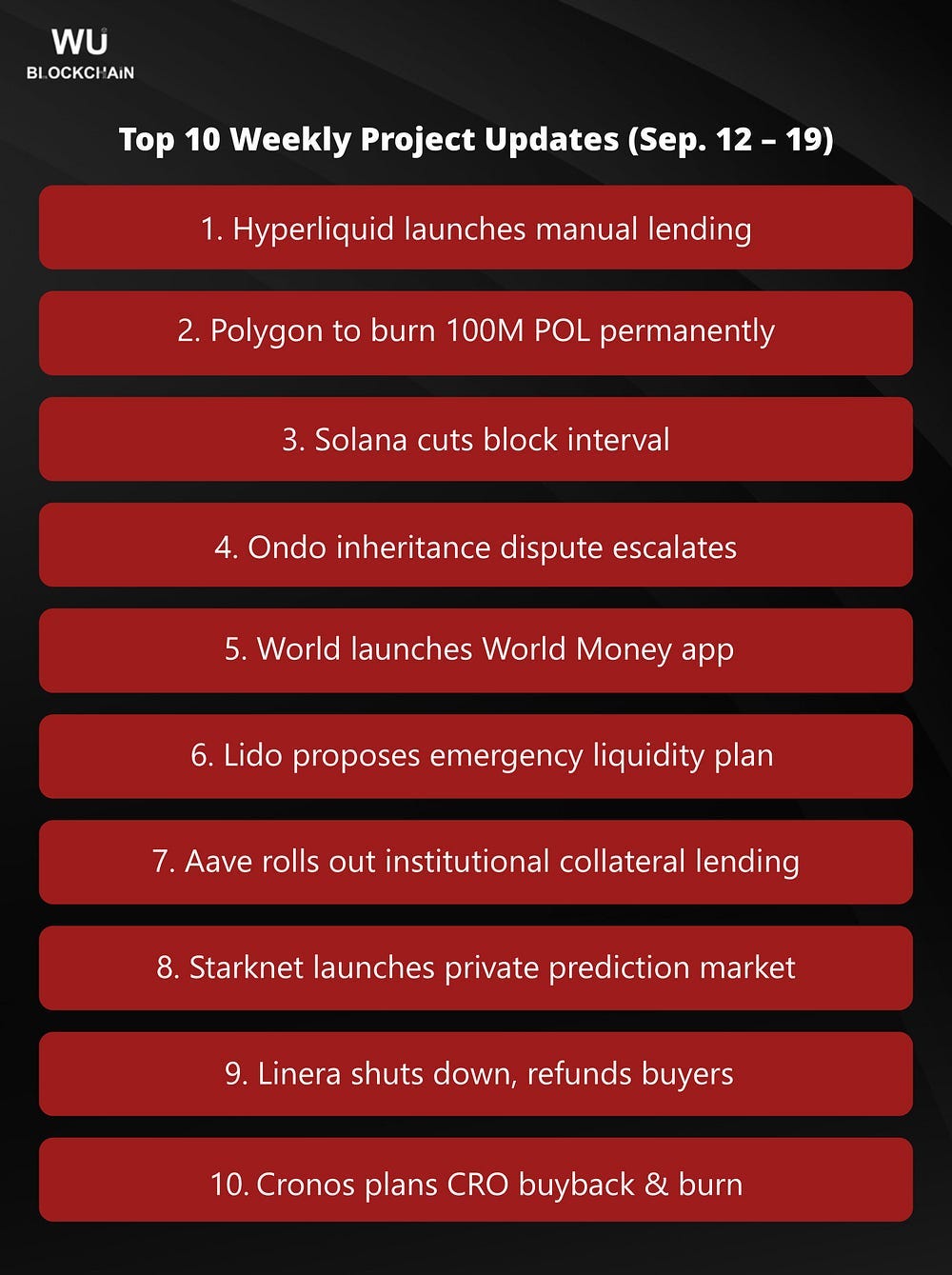
1. Hyperliquid Launches Manual Lending with HYPE & BTC Collateral for USDC/USDT Borrowing link
Hyperliquid announced the launch of manual lending and borrowing functionality. Users may use HYPE and BTC as collateral to borrow denominated assets such as USDC and USDT. Interest is charged on borrowed assets, while interest can be earned by supplying denominated assets, with rates determined by capital utilization. This feature shares the HyperCore infrastructure with portfolio margin, and the lending and borrowing asset volume has reached $269 million today.
Jeff Yan, co-founder of Hyperliquid, stated that the platform adopts a modular design. A standalone lending protocol is first built on HyperCore, and lending and borrowing are then integrated with perpetual contracts, spot trading and trading outcomes through the portfolio margin system. He believes this architecture enables independent management of lending risks, allows idle stablecoin collateral to generate interest income, and facilitates analysis of overall system risks.
2. Polygon Plans Permanent Burn of 100M POL; Quarterly Community Burns to Follow link
Polygon Foundation CEO Sandeep Nailwal stated that Polygon plans to permanently burn 100 million POL. The relevant contract has been deployed to the testnet and will go live on the mainnet after the Security Council completes final signatures. After that, the community may continue to burn POL flowing into the fee collector on a quarterly basis. POL has been in a deflationary state since January 2026. Network base fees keep flowing into the fee collector, which has accumulated approximately 121 million POL to date. Polygon’s revenue for 2026 so far stands at $24.5 million.
3. Solana Shortens Block Target Interval to 250ms, 17% Speed Gain Without Higher Throughput link
Solana has reduced the target block interval from 300 milliseconds to 250 milliseconds, targeting 4 slots per second. However, the compute and data capacity per slot has been cut accordingly, leaving the overall transaction capacity largely unchanged. This adjustment will deliver more timely on-chain data for wallets, exchanges and trading applications, and shorten the epoch duration to approximately 30 hours, yet it narrows the time window for offline signatures and delayed approvals. A further reduction to 200 milliseconds has no confirmed mainnet launch date.
4. Ondo Finance Inheritance Dispute Escalates; Founder’s Sister Seeks Restriction on Mother’s Estate Control link
Nathan Allman, founder of Ondo Finance, passed away in May this year without leaving a will. His parents subsequently inherited the estate including controlling stakes in Ondo and a large amount of ONDO tokens. Lani Clinton, Nathan’s half-sister, and David Chen, an Ondo investor, recently filed an application with a Hawaii court to establish limited guardianship over the estate interests of 77-year-old Kathleen Allman. They claimed that Kathleen has long suffered from alcohol abuse as well as impaired cognitive and judgmental abilities, and requested the court to assess whether she has dementia. Kathleen denies these allegations, stating that the application is another move by the camp of interim CEO Ian De Bode to seize control of Ondo. Kathleen previously sued De Bode, accusing him of attempting to take over control of the company after Nathan’s death and arranging over $10 million worth of compensation and equity rewards for himself.
5. World Unveils Financial App World Money Integrating Stripe, Kalshi and Morpho link
World announced the launch of World Money, a self-custodial financial application, rolled out in over 150 countries and regions globally. The app features stablecoin payments, investment, yield-generating wealth management and global cross-border transfer functions. It supports balances in 8 fiat currencies and digital assets, and integrates Stripe to enable U.S. users to fund accounts quickly via Apple Pay for stablecoin conversion. In addition, World Money has deep integrations with prediction market platform Kalshi and decentralized lending protocol Morpho.
6. Lido Community Proposal Seeks Authorization for Emergency CEX Liquidity Market-Making link
The Lido community has put forward a new proposal seeking authorization for an emergency LDO CEX liquidity market-making mechanism. It aims to address risks such as deteriorated liquidity or delisting from exchanges caused by weakened natural market-making incentives among market makers amid declining LDO trading volume. The authorization will remain valid for a 2-year window upon approval. Once the Growth Committee determines that LDO exchange liquidity is insufficient and triggers activation, up to $1.5 million worth of LDO will be allocated from the Lido DAO treasury as a recallable market-making inventory loan limit, and a maximum of 480,000 USDC will be used for fixed market-making service fees and related expenses over a 12-month period. The Lido Ecosystem Foundation will prioritize the solution using foundation-held CEX accounts with restricted API permissions. Market makers are prohibited from being granted withdrawal rights, and borrowed LDO cannot be used for governance voting. Market manipulation and ancillary structures such as call options are explicitly banned.

Sponsored by FinTax
7. Aave Proposal Introduces Custodial Collateral Lending for Institutions Using Anchorage-Held Assets link
Aave has submitted a new governance proposal to launch Custodied Collateral Lending based on Aave V4. It allows institutions to borrow stablecoins using assets custodied at Anchorage as collateral. The underlying collateral assets will remain under Anchorage’s custody throughout the loan term. Anchorage will maintain the collateral management system, record balances and loan lifecycle events, and sell underlying assets via OTC in the event of liquidation. Chainlink CustodySync will sync custodied balances on-chain in the form of non-transferable receipt tokens, while Chainlink Price Feeds provide consistent pricing data to Aave and the custodian to synchronize LTV. Borrowed stablecoins can be sent directly to the borrower’s address in a single transaction. The solution will operate within a standalone Liquidity Hub on Aave V4, isolated from existing markets.
8. Starknet Rolls Out Private Prediction Market Trading to Mask User Transaction Links link
Starknet ecosystem officials announced that Off Market, a privacy-focused prediction market trading service built on Polymarket, has launched on the Starknet mainnet. Users can establish prediction market positions without publicly linking trading activity to their accounts. The service is designed to reduce information exposure of on-chain holdings and trading behavior. Previously, Starknet rolled out the STRK20 privacy framework to enable privacy features for on-chain assets and applications.
9. Linera Shuts Down Operations Due to Funding Shortfall; All Token Sale Subscriptions Refunded link
The Linera team released an announcement on Discord stating that the project will cease operations immediately due to insufficient funding. Its token sale on the Sonar platform secured nearly $900,000 in subscription commitments but failed to meet the minimum threshold required to complete the sale, and all subscription funds have been refunded. The team subsequently attempted to secure emergency financing to bring the company to mainnet launch, yet was unable to raise the required capital.
Linera is now gradually shutting down its applications and Discord community. Records of user point balances will be retained, but the team cannot guarantee any future entitlements tied to these points. The team noted that it still hopes to finish protocol development and launch applications in the future, though no timeline can be provided at present. Founded by former Meta researcher Mathieu Baudet, Linera raised approximately $12 million across two funding rounds in 2022 and 2023. a16z participated in both rounds, alongside other investors including Borderless Capital, GSR, Matrixport Ventures and Flow Traders.
10. Cronos Proposal Directs All Ult and Cronos Launch Revenue to CRO Buyback & Burn link
Lezzokafka, maintainer of the Cronos GitHub repository, has released a governance proposal. It plans to allocate all revenue from Ult and Cronos Launch under Cronos Labs to repurchase CRO on the open market, burn the tokens on-chain monthly, and publish the hash of each burn transaction. Expenses related to operations, infrastructure and growth will be covered by existing capital. Meanwhile, the proposal intends to use strategic reserves to back future staking rewards for Cronos POS, topping up rewards as token issuance declines to keep existing staking parameters unchanged. The proposal has entered the voting phase as on-chain governance proposal №37. Voting will conclude at 10:02 Beijing Time on October 3, and the buyback-and-burn contract is still under development.
Follow us
Twitter: https://twitter.com/WuBlockchain
Telegram: https://t.me/wublockchainenglish