
Weekly Project Updates: Hyperliquid Perp Volume Hits Record, Radiant Capital Prepares Shutdown, Hacker Drains Kelp DAO Bridge Funds, etc


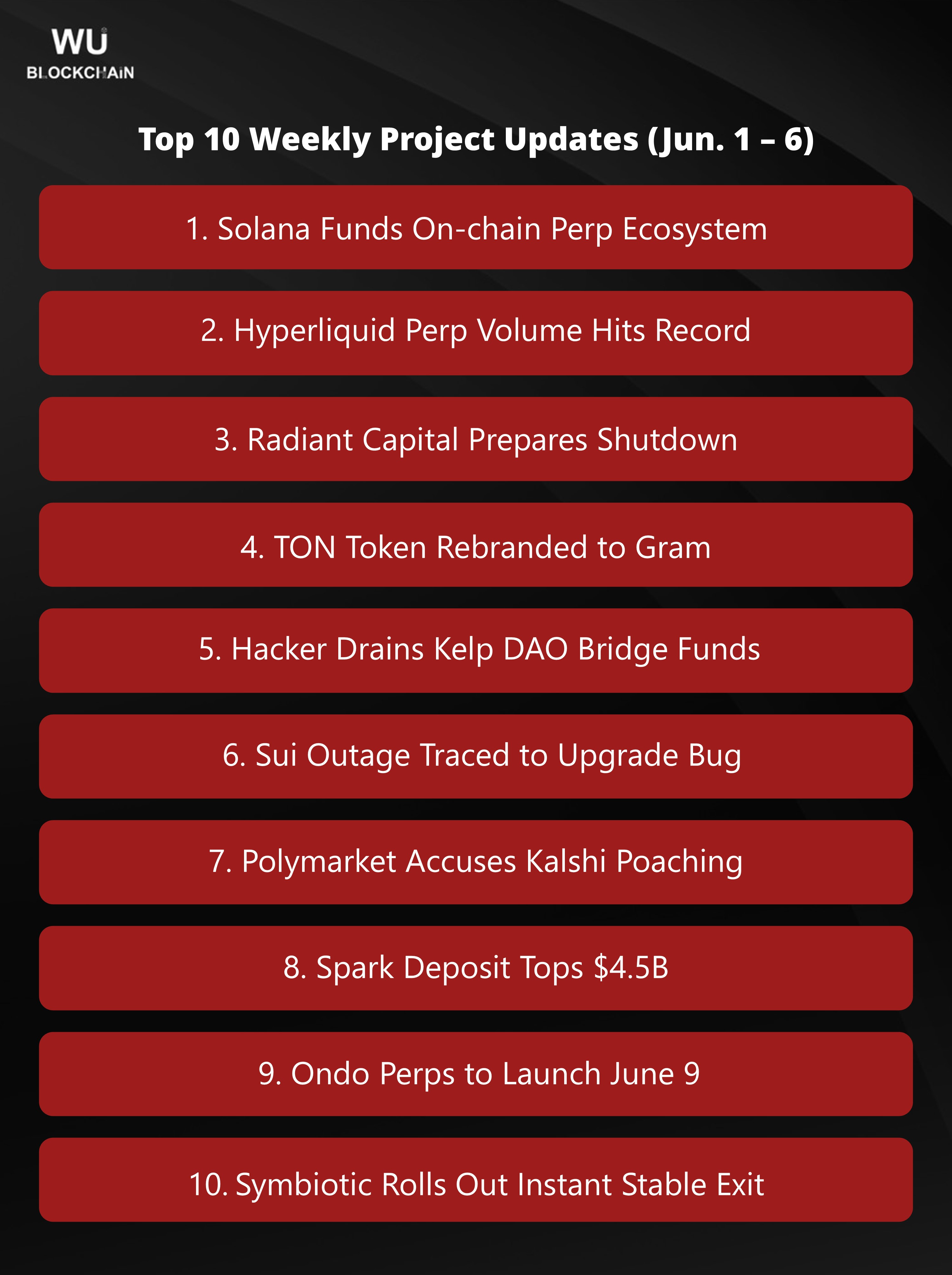
1. Solana Foundation rolls out dedicated grant program to boost fully on-chain perpetual futures ecosystem link
The Solana Foundation announced support for developing fully on-chain perpetual contracts and other derivative applications on Solana with traffic, technical and financial resources. It stated hybrid architectures using off-chain matching are only transitional and full on-chain operation is the ultimate target. Six supporting principles are released: full on-chain execution of order placement, matching and settlement; genuine price discovery via two-way liquidity of order book or RFQ instead of pool pricing; Solana-first rule with structured revenue feedback to the public chain; incentives for architectural and network optimization innovation; priority for mature teams shifting to full on-chain frameworks; preferential funding for open-source teams with verifiable core logic.
2. Hyperliquid emerges as core weekend perps hub for Wall Street traders, hitting all-time-high perp trading share in May link
According to The Wall Street Journal, Hyperliquid has become a key venue for some Wall Street traders to trade perpetual contracts of crypto and traditional assets on weekends and off-market hours, with products covering BTC, S&P 500, crude oil and contracts linked to unlisted assets such as SpaceX, generating around $800 million in total revenue last year. The WSJ notes Hyperliquid blocks access for US residents, yet traders from restricted jurisdictions circumvent restrictions via VPN, while its robust community ecosystem and diversified asset lineup fuel expansion into prediction markets and options trading.
Data from The Block shows Hyperliquid’s May perpetual trading volume accounted for a record-high 6.63% of global centralized exchange aggregate volume and hit an all-time peak of 14.4% relative to Binance. Its HIP-3 framework underpinned the expansion, driving over $62 billion in monthly trading volume and roughly $3 billion in open interest in May. Even so, the report highlights Hyperliquid’s standalone crypto perpetual trading volume posted a notable year-on-year decline amid broad crypto market downturn.
3. Radiant Capital initiates phased orderly wind-down of all protocol operations link
Radiant Capital announced its DAO has no viable path for sustainable operations and will commence phased shutdown after failing to recover stolen funds, secure fresh financing or resume growth following an October 2024 exploit. Front-end interfaces and on-chain smart contracts remain functional for users to withdraw funds, settle loans and manage positions, yet all development, upgrades and expansion initiatives are halted alongside zeroed lending caps and terminated RDNT reward distributions. The team will focus on safeguarding user assets, pursuing fund recovery and facilitating orderly wind-down. The protocol suffered losses exceeding $50 million in the prior hack.
4. TON’s native token rebrands to Gram; underlying TON blockchain name stays unchanged link
Pavel Durov, founder of Telegram, announced the launch of a rebranding initiative across the TON ecosystem, renaming its native token from TON to Gram. The team noted Gram was the original native token name outlined in TON’s initial whitepaper, with the rename intended to return to the project’s founding vision and mark a new development phase for the ecosystem. The brand transition is set to roll out incrementally over roughly three weeks, with wallets, infrastructure and ecosystem applications updating the token designation sequentially. TON clarified the change only applies to the native token’s brand name, and the underlying blockchain will retain the official title The Open Network (TON) with no alterations.

Sponsored by FinTax
5. Hacker launders nearly all $220M unfrozen funds from Kelp DAO bridge exploit, asset tracing window effectively closed link
On-chain tracking data confirms the Kelp DAO cross-chain bridge hacker, identified as North Korean hacking syndicate TraderTraitor, has laundered approximately $220 million in unfrozen stolen assets via privacy protocols including THORChain, Wasabi, Tornado Cash and Umbra. Merely around $1.7 million of funds remains parked in the hacker’s original wallet, practically shutting down the window for itemized tracing and direct recovery of unfrozen capital.
6. Sui confirms three consecutive mainnet outages stem from v1.72 upgrade code bugs link
Sui Foundation revealed three outages hitting the Sui mainnet last Thursday and Friday stemmed from two distinct bugs introduced in the v1.72 upgrade. The first two shutdowns originated from a gas calculation flaw within the address balances function. The emergency patch rolled out on Thursday carried a documented low-probability crash risk, which the team accepted to restore service promptly and triggered another outage on Friday. The third downtime emerged after validators rebooted to apply fixes, tied to a hidden bug governing the network’s stored randomness configuration. Sui confirmed all defects have been patched with no user funds compromised or finalized transactions reversed, alongside a newly built mechanism to forcibly terminate stuck epochs.
7. Polymarket suspects industrial espionage from Kalshi, citing excessive coincidences on parallel product launches link
Polymarket suspects rival Kalshi of corporate espionage and has compiled internal documentation dubbed “copycat” detailing roughly a dozen alleged instances of replicated or pre-emptively launched products, marketing campaigns and UI layouts. Matthew Modabber, Polymarket’s head of market operations, states the occurrences exceed coincidences, citing examples such as a free grocery pop-up event in New York and perpetual contract offerings. Kalshi refutes the accusations as delusional and commits to ongoing product development. Paradigm, an investor in Kalshi, also denies conducting surveillance on Polymarket’s premises.
8. Spark’s total deposits near $4.5B, notching successive all-time highs link
Per Blockworks statistics, total deposits on lending protocol Spark have neared $4.5 billion, hitting successive all-time highs, with over $1 billion in fresh inflows registered since late April’s rsETH incident. USDS now accounts for more than half of all funds parked on the platform.
9. Ondo Perps slated to launch equity perpetual contracts on June 9, 2026 link
Ondo Perps posted on X stating, “Perpetual contracts transformed global trading, and now they are set to enter the stock market,” previewing its official launch slated for June 9, 2026. Early access applications are currently open to a limited pool of eligible traders. The platform facilitates peer-to-peer perpetual contract trading and restricts service to end-users based in jurisdictions including the United States, Canada, the United Kingdom, the European Union and Panama.
10. Symbiotic launches Liquid Lane network enabling instant stablecoin redemptions for tokenized RWAs link
Backed by Paradigm, Pantera Capital and Coinbase Ventures, crypto infrastructure firm Symbiotic has rolled out Liquid Lane to resolve the lengthy redemption cycles plaguing real-world asset products including tokenized funds and private credit.
Symbiotic notes that while many tokenized holdings can be transferred on-chain instantaneously, investors may wait weeks or even up to 180 days to receive fiat cash from issuers via formal redemption channels. Powered by a request-for-quote mechanism, Liquid Lane routes investor exit orders to vetted market makers; the winning bidder pays out USDC to investors upfront and takes possession of the corresponding tokenized assets, with issuers wrapping up underlying settlement off-chain in the background.
Follow us
Twitter: https://twitter.com/WuBlockchain
Telegram: https://t.me/wublockchainenglish