
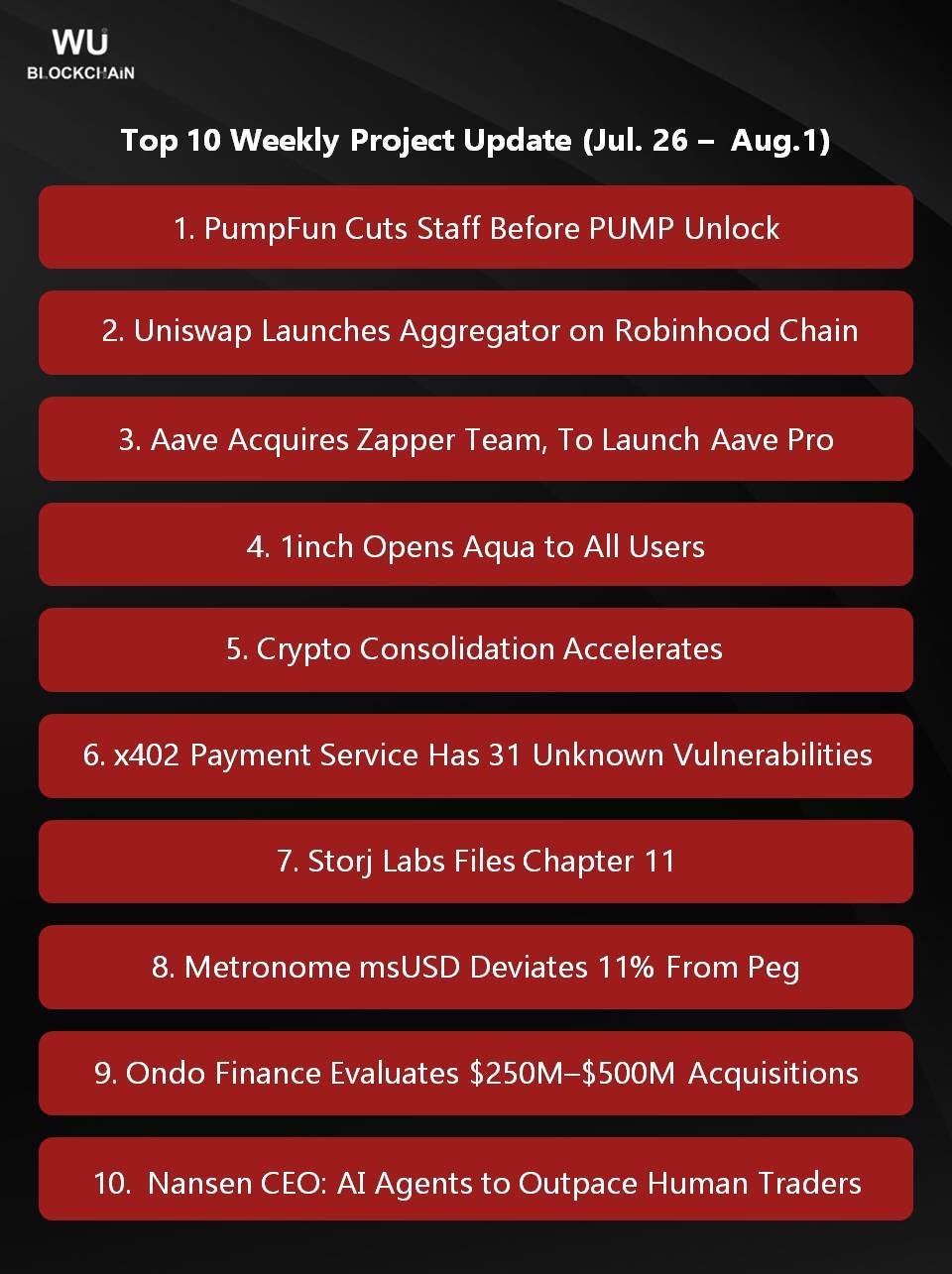
Weekly Project Updates: PumpFun Cuts Staff Before PUMP Unlock, Uniswap Launches Aggregator on Robinhood Chain, Aave Set to Launch Aave Pro Soon, etc


1. Pump fun Reportedly Conducts Layoffs Before PUMP Unlock; At Least One Ex-Employee Loses Seven-Figure Token Allocation link
Solana ecosystem meme coin launch platform Pump Fun laid off some staff in early April, around two months ahead of the first PUMP token unlock. At least one former employee missed out on token grants worth over $1 million at current prices. Pump Fun co-founder Noah Tweedale said in an internal meeting that the company had “expanded too quickly.” Former employees also claimed another round of cuts occurred in mid-July, with more than 40 people dismissed across two months, though the figure has not been independently verified. The Pump Fun co-founder did not respond to requests for comment.
2. Uniswap Launches Token Launch Aggregator “Launches”, With Robinhood Chain Supported at Launch link
Uniswap announced the launch of a new beta feature called “Launches,” a new tab within the Uniswap Web App designed to aggregate and showcase leading Uniswap token launch platforms. Many launchpad builders including Bankr, Pons and Long have selected Uniswap as their trading infrastructure. The feature initially rolled out on Robinhood Chain for token launch exploration, with additional networks to be integrated later.
Uniswap also partnered with decentralized lending protocol Morpho to launch the Earn yield product. Users can deposit USDC, USDT and ETH into three Gauntlet-managed Morpho vaults directly within the Uniswap web app and wallet to earn interest by supplying capital to Morpho’s lending markets. Uniswap stated the product operates on a non-custodial model; users retain full control of their assets and may deposit or withdraw funds at any time.
3. Aave Founder Stani: Zapper Engineering Team Acquired; Aave Pro Set to Launch Soon link
Aave founder Stani Kulechov posted on X welcoming the Zapper team, noting that users who like Zapper will also embrace the upcoming Aave Pro. Aave has fully acquired Zapper’s entire engineering team and will continue refining related products and services.
Stani Kulechov also stated that the protocol will phase out 50 low-utilization asset reserves and gradually shut deployments on Sonic, Scroll, zkSync, Metis, Soneium and Aptos, alongside delisting 21 expired Pendle PTs. The changes cover approximately $98.1 million in deposits and $15.6 million in debt, aimed at reducing economic and technical risks. Aave had previously begun winding down presence on some low-activity networks.
Stani Kulechov said recent delistings and network reductions should not be overinterpreted as a stance against any L1 or L2. The core goal is simply to shrink Aave’s operational, technical and economic exposure so resources can focus on higher-impact priorities: scaling existing high-value markets and expanding securities finance. He emphasized that L2s remain critical for user experience on Ethereum, citing Aave App’s Stable Vaults using L2s as a ledger layer to bring mainstream users into DeFi, while networks such as Avalanche play an important role in onboarding real-world assets (RWA) via institutional business.
4. 1inch Opens Aqua to All Users; Shared Liquidity Enables Multiple Positions From a Single Balance link
1inch announced the opening of Aqua, its self-custodial shared liquidity layer, to all users. Users can deploy the same wallet balance across multiple trading pairs and liquidity positions without pre-depositing assets into pools; tokens are only transferred from the wallet when trades execute. Aqua initially supports 13 EVM networks including Ethereum, Arbitrum, Base, Robinhood Chain and BNB Chain, and incorporates verified counterparties plus JIT fee-frontrunning protection.
5. Hyperliquid, PumpFun and Ethena Generate Nearly 80% of App Revenue; Crypto Industry Consolidation May Accelerate link
Lorenzo Valente, researcher at ARK Invest, said the crypto industry is undergoing a deeper consolidation than prior bear markets, with capital allocation growing more concentrated. Teams and trading platforms lacking genuine product-market fit are exiting. Revenue concentration is high across applications, infrastructure and L1 layers. Hyperliquid and PumpFun together account for 67% of total application revenue; adding Ethena brings the top three projects to nearly 80%. He expects more mergers, bankruptcy filings, project shutdowns and talent acquisitions in the coming months.

Sponsored by FinTax
6. Research Finds 31 Unknown Vulnerabilities in x402 Payment Providers, Covering 99% of Relevant Transactions link
A study published on July 21 found 31 previously unknown vulnerabilities across 15 major x402 payment providers, covering 99% of relevant transactions during the research period. Researchers confirmed two flaws enabling “free shopping” and identified high-risk paths including asset theft, denial of service and gas misuse, though they did not prove vulnerabilities exist in all x402 payments or within Coinbase itself. Coinbase, PayAI and Mogami have acknowledged some of the issues and initiated fixes. The study recommends merchants deliver services only after on-chain settlement is confirmed.
7. Storj Labs Files for U.S. Chapter 11 Restructuring; Business Operations to Continue link
Storj Labs, parent company of decentralized cloud storage project Storj, announced that it has voluntarily filed for Chapter 11 bankruptcy reorganization in the United States to resolve legacy debt while continuing operations. The firm stated that business will proceed normally during restructuring with no disruption to customer service, and intends for the reorganized company to be jointly owned by management, the community, STORJ token holders and investors. Founded in 2014, Storj operates a decentralized storage network where users supply cloud storage to global clients by sharing unused hard drive space, with STORJ tokens used for incentives and payments.
8. Metronome msUSD Breaks Peg by 11%; Synthetic Asset Module Triggers msETH/msUSD Under-Collateralization link
Blockaid, a blockchain security firm, stated that Metronome DAO’s synthetic dollar msUSD traded roughly 11% below its peg on Ethereum, Base and Optimism. Metronome DAO later released a post-mortem noting undercollateralization for msETH and msUSD. The issue stemmed from uncollateralized circulating supply created by the synthetic asset swap module, leaving some synthetic assets without adequate backing. At the time of the report, the gap between circulating synthetic assets and corresponding debt positions stood at approximately 6,367 msETH and 4.57 million msUSD. Metronome attributed the root cause to delayed Chainlink oracle updates during synthetic asset swaps, allowing price slippage to accumulate and generate uncollateralized supply. The team said it established defensive positions using treasury funds, raised trading fees and upgraded contract mechanics, and advised liquidity providers to take no immediate action.
9. Ondo Finance Evaluates Potential Acquisitions Worth $250 Million to $500 Million, Targeting Wealth Tech Firms link
Ondo Finance is considering an acquisition valued between $250 million and $500 million, with potential targets spanning wealth technology and related sectors, though no formal advisors have been retained. Ondo responded that it continuously evaluates market opportunities in ordinary course and is not negotiating with any counterparty at this stage. Founded in 2021, Ondo Finance primarily offers on-chain financial products such as tokenized US Treasury bonds and equities, with assets under its products exceeding $2.5 billion.
10. Nansen CEO: AI Trading Agents May Outperform Human Traders Within Two Years link
Alex Svanevik, co-founder and CEO of on-chain analytics platform Nansen, said the number of AI trading agents could surpass human traders within roughly two years. Nansen is shifting from an analytics platform toward on-chain trade execution. Since launching direct trading functionality, the platform has recorded over $500 million in cumulative volume. Around 10 of its top 15 perpetual contracts by volume are non-crypto assets including SpaceX, the S&P 500, gold and crude oil. The agents remain in backtesting and simulation; in one test, the system generated only $23 in profit while incurring roughly $700 in inference costs.
Follow us
Twitter: https://twitter.com/WuBlockchain
Telegram: https://t.me/wublockchainenglish