
Weekly Project Updates: Robinhood Chain Booms On‑Chain, ENS Foundation Becomes Formal Entity, Jupiter Unveils Lend v2, etc


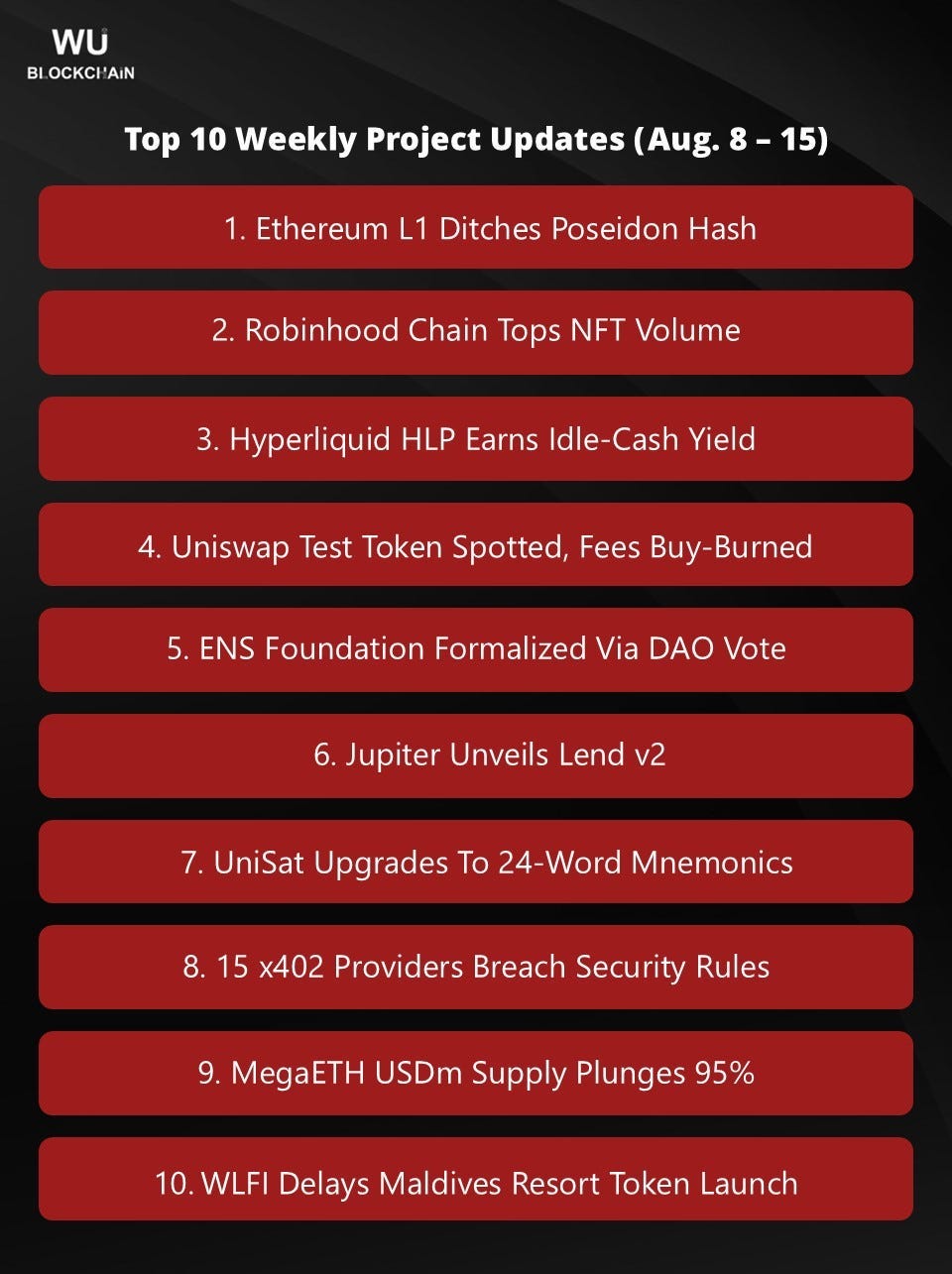
1. Ethereum L1 to Abandon Poseidon, Shift to SHA or BLAKE Hash Schemes link
Justin Drake, researcher at the Ethereum Foundation, stated that the EF will no longer advance Poseidon as the hash scheme for Ethereum L1, and will instead adopt traditional hash functions such as SHA or BLAKE. Recent breakthroughs in binary‑field‑based SNARK design enable conventional hash functions including SHA2 and BLAKE2s to deliver SNARK‑performance comparable to Poseidon. This reduces reliance on specialized SNARK‑friendly hash functions and steers Ethereum toward a hash‑heavy post‑quantum cryptography roadmap. Drake noted that the EF post‑quantum team is pursuing development along this direction. The current roadmap targets a production‑grade leanVM in 2027, followed by deployments across the consensus, data and execution layers in 2028.
2. Robinhood Chain Becomes the Largest Network by NFT Trading Volume link
Robinhood Chain’s daily NFT trading volume hit $3.13 million, surpassing Ethereum to become the network with the largest NFT trading volume. The recent popularity of combinations of NFT, meme‑coin and RWA gameplay represented by StonkBrokers on Robinhood Chain has driven the surge in NFT trading volume on the chain, and the market cap of StonkBrokers NFT once exceeded that of BAYC.
Robinhood Chain recorded an average of 11.6 million daily transactions last week, hitting a new all‑time high and rising by roughly 30 % week‑on‑week. Its on‑chain total value locked (TVL) climbed to $473 million, representing a 32 % weekly increase. Nevertheless, daily active accounts grew by merely 3.3 % and remained 11 % below the peak recorded on July 16, indicating that the growth in trading volume and TVL has not translated into user‑base expansion. Meanwhile, the supply of USDe on Robinhood Chain has expanded from $17 million one month ago to $253 million, accounting for approximately 43 % of the chain’s total stablecoin supply and serving as a key driver of TVL growth.
3. Hyperliquid to Enable Auto‑Earn Native Lending Interest for Unused HLP Cash link
Hyperliquid founder Jeff announced that following the next network upgrade, HLP will automatically deploy USDC not utilized for market‑making into the HyperCore native lending pool to accrue interest. On‑chain data shows HLP currently holds approximately $188.7 million in TVL, of which around $148.7 million sits as idle cash in the main account, accounting for nearly 79 % of total capital, with another $40.06 million allocated across seven sub‑strategies. The Hyperliquid native lending pool presently has about $176 million in USDC supplied and $112 million borrowed, corresponding to a 63.7 % utilization rate, a 5 % annualized borrowing rate and roughly 2.87 % annualized supply yield. This move marks HLP’s evolution from a pool primarily for market‑making and liquidation purposes toward a multi‑strategy vault with automated capital allocation.
4. Uniswap Test Token Discovered by Market; Team Switches All Creator Fees to Buy‑and‑Burn link
Uniswap founder Hayden Adams stated that tokens created by the team during Pools trade testing were never meant to be discovered externally. All creator fees generated from Uniswap‑staff‑led tests have now been waived, and both past and future relevant fees will be routed to an auto‑buy‑and‑burn contract. Fees will be unlocked in ETH, and anyone may claim the ETH by burning the corresponding tokens. Adams added that he is considering opening this mechanism for other token deployers.
5. ENS DAO Passes Governance Proposal; ENS Foundation Becomes Formal Operator link
Ethereum Name Service (ENS) announced that token holders have passed and executed the “Next Era of ENS DAO” proposal, establishing the ENS Foundation as a formal operating body with a full‑time executive director, staff and a five‑member board of directors. The foundation will handle engagements with bodies including ICANN, IETF and W3C, advance work on the .ens top‑level domain, conduct regulatory outreach and manage brand protection, while ENS Labs will remain in charge of protocol and product development. The ENS tokens held by the DAO account for 54.6 % of the total supply and remain under token‑holder control; only a one‑time allocation of 1 million ENS has been transferred to the foundation to cover staff compensation under the established framework.
Transactions for the ENS Endowment will adopt an additional 9‑day timelock, and the ENS Security Council is empowered to block operations exceeding the foundation’s authorized scope. Foundation board directors are appointed and removed by token holders. The inaugural five‑member board comprises Executive Director Alexander Urbelis, ENS founder Nick Johnson, alongside Kartik Talwar, Brett Sun and Anthony Leutenegger.

Sponsored by FinTax
6. Solana‑Based Lending Protocol Jupiter Launches Lend v2 link
Solana‑ecosystem lending protocol Jupiter has launched Lend v2, enabling deposited and borrowed assets to simultaneously serve as trading liquidity, so the same capital can generate both lending yields and swap fees. The new release includes optional Smart Collateral and Smart Debt features. Smart Collateral automatically deploys USDC, USDT, SOL or JupSOL into highly‑correlated liquidity pools, while Smart Debt lets borrowed assets accrue trading fees to offset part of borrowing costs. Jupiter Lend currently holds roughly $1.9 billion in deposits and around $823 million in active loans.
7. UniSat Raises Default Wallet Mnemonic From 12 to 24 Words; Existing Users Require No Urgent Migration link
UniSat has released its August 2026 security update. Browser‑extension wallet version v1.7.19 changes the default mnemonic length for newly‑created wallets from 12‑word to 24‑word, and optimizes wallet‑creation and mnemonic‑management workflows. UniSat states that this represents a long‑term security‑configuration upgrade. Existing 12‑word wallets remain BIP‑39‑compliant and do not require urgent migration solely due to the revised default setting. Multiple recent community‑submitted security reports have also been addressed via fixes or hardening measures based on impact scope.
8. 15 x402 Payment Service Providers Including Coinbase Each Violate At Least One Security Rule link
A study published at the 35th USENIX Security Symposium tested 15 major x402 payment service providers including Coinbase, Thirdweb, PayAI and Mogami, finding that every tested platform violated at least one security rule, with a total of 49 rule violations and 31 distinct vulnerabilities. The covered providers accounted for 99 % of x402‑transaction volume and 98 % of payment value during the study period, though this does not imply vulnerabilities exist for the same share of transactions. The research categorized risks as free‑of‑charge goods or‑service acquisition, asset theft, service disruption and gas‑fee abuse, and validated six attack paths under constrained conditions; researchers did not actually transfer provider‑held assets. Coinbase, PayAI and Mogami collectively acknowledged six vulnerabilities, some of which have been fixed while others remain in progress. The real‑world deployment scope of these fixes across live x402 infrastructure remains unclear.
9. MegaETH Native Stablecoin USDm Supply Plunges Over 95% From Peak to Around $18 Million link
The current supply of MegaETH‑native stablecoin USDm stands at around $18 million, representing a drop of over 95 % from its roughly $600‑million peak in May this year. Launched jointly by MegaETH and Ethena, USDm deploys its reserve capital into BlackRock’s BUIDL fund, with generated yields used for MegaETH token buy‑and‑burn operations. Based on the present $18‑million supply and a 3.6 % SOFR rate, Castle Labs estimates USDm can generate approximately $650,000 in annual yield, and attributes the sharp supply contraction to declining on‑chain usage on MegaETH.
10. World Liberty Financial Delays Revenue‑Sharing Token for Maldives Trump‑Branded Resort Amid Iran Conflict link
World Liberty Financial and its partners have postponed the digital‑token issuance tied to the Trump‑branded resort development in the Maldives. Originally scheduled for launch this spring, the token would have granted investors partial proceeds from financing loans for the resort. The rollout has been delayed amid regional‑travel disruptions stemming from the Iran‑related conflict, and no new launch date has been set. Developed by UK‑listed firm DAR Global, the project was intended as one of World Liberty’s flagship real‑world‑asset tokenization initiatives. The firm had previously also discussed tokenizing real‑estate properties, investment funds, oil and gold.
Follow us
Twitter: https://twitter.com/WuBlockchain
Telegram: https://t.me/wublockchainenglish