
WuBlockchain Weekly: Ethereum Foundation Restructures, STRC Hits Record Low and Chainlink Unveils Instant Cross-border Payments, etc


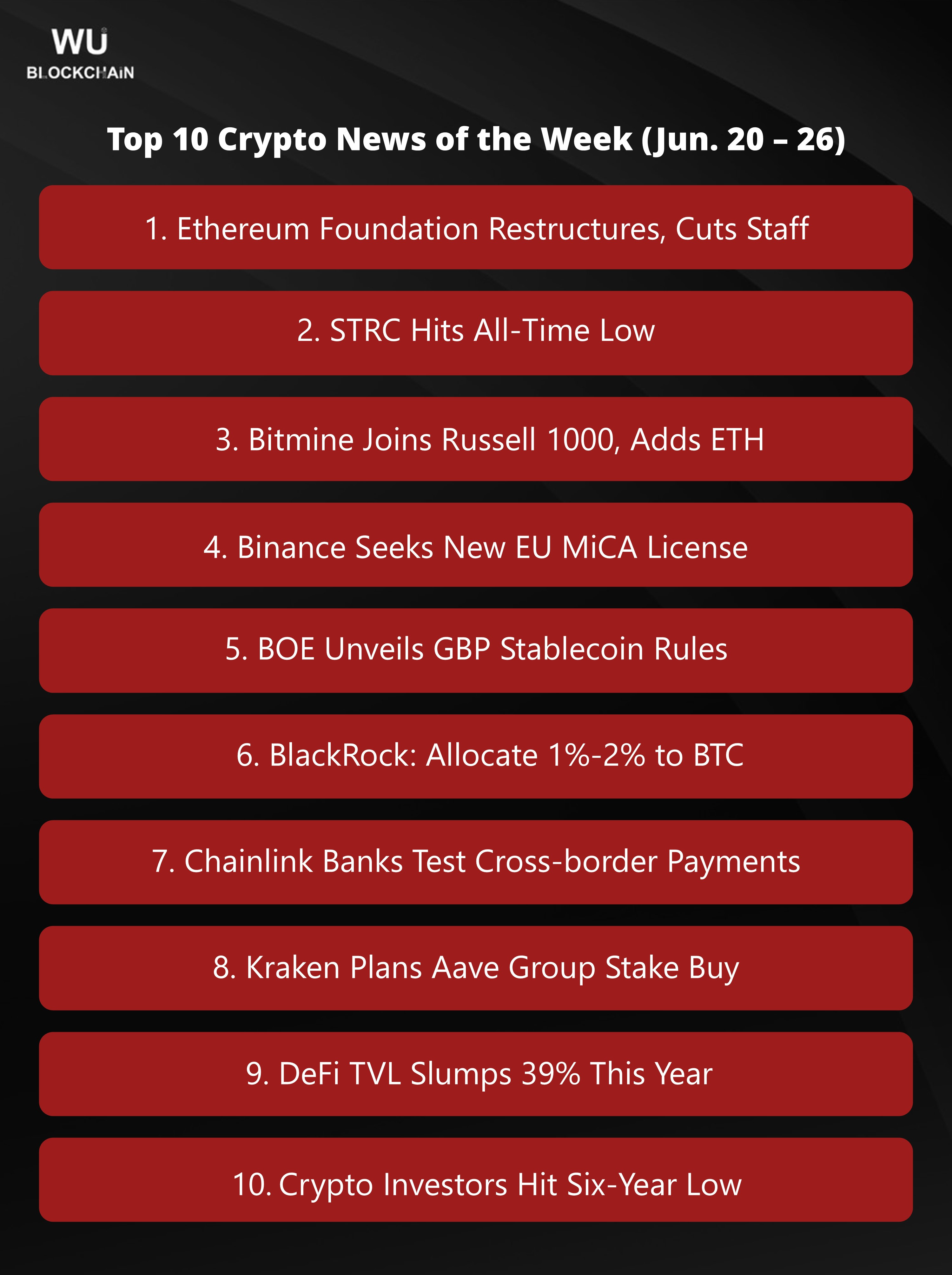
1. Ethereum Foundation Completes Restructuring, Cuts Staff by 20% and Slashes Budget by 40% link
The Ethereum Foundation (EF) released a new organizational structure, stating it has completed a restructuring process spanning several months. The EF said the revamp will create five core work clusters: Protocol Layer, Access Layer, User Layer, Community Layer and Institutional Layer, alongside an Operations Cluster and management and administrative support teams. A total of 54 staff members, roughly 20% of the EF’s workforce, will depart as part of the changes, receiving severance packages and transition support. The EF noted the restructured organization will be leaner and more focused on core priorities.
Ethereum co-founder Vitalik Buterin posted that the Ethereum Foundation’s budget will be cut by approximately 40% this year. The EF is shifting from its pre-2026 model of spending an average of 15% of its residual funds annually toward an endowment-style long-term framework, aiming to reduce yearly expenditures to around 5% after 2030. Vitalik stated the EF will not scale back its goals for the Ethereum protocol, yet several tradeoffs will be made: the multi-client model will shift emphasis from redundancy to specialization; AI-aided formal verification will be explored; the PSE unit will wind down as an independent entity; future Devcon events may be smaller with lower deficits; and the EF’s institutional outreach work will narrow in scope.
Toly, co-founder of Solana, responded that the news is highly positive. He argued budget constraints will force teams to clarify priorities and stay focused. He added Ethereum is not at risk of fading, and a smaller, streamlined Ethereum Foundation will be more decisive, agile, and capable of pivoting directions faster.
2. Strategy Preferred Stock STRC Hits All-Time Low of $73.77 Intraday link
On June 25, Strategy’s preferred stock STRC briefly slumped to an all-time low of $73.77 and was trading at $77.21 at press time, representing an 8.64% drop in 24 hours. MicroStrategy (ticker: MSTR) dipped below $90 intraday to settle at $90.05, down 8.44% over 24 hours. Stablecoin developer Circle (ticker: CRCL) fell under $70 to $69.24, with a 24-hour loss of 3.97%.
The 90-day correlation coefficient between Strategy’s perpetual preferred stock STRC and Bitcoin has climbed to nearly 0.70, the highest level since STRC’s launch in July 2025, eroding its appeal as a relatively steady income vehicle. STRC has tumbled 23% this month to $76, far below its $100 par value, while Bitcoin lost almost 20% over the same period to trade under $60,000. STRC carries an annualized dividend yield of 11.5% at present, yet its trading price below par restricts Strategy’s capacity to raise funds via new issuances for Bitcoin purchases.
According to an 8-K filing submitted by Strategy to the U.S. SEC, the company acquired 520 Bitcoin at an average price of roughly $67,068 between June 15 and 21, 2026, for a total outlay of approximately $34.9 million, funded by proceeds from MSTR’s equity ATM program. Over the same timeframe, the firm sold 2.7148 million MSTR common shares through the ATM mechanism, raising around $335.5 million in net proceeds. As of June 21, 2026, Strategy held a cumulative 847,363 Bitcoin with an aggregate cost basis of about $64.1 billion and an average acquisition price of $75,651. Its cash reserves stood at $1.4 billion as of June 21, a $300 million increase week-on-week.
Analyst Adam Livingston posted on social media that he ran a three-year stress test on MSTR with the following assumptions: Bitcoin dropping to $26,611 in the sixth month, market net asset value multiple (mNAV) falling below 0.50, closed capital markets, and forced Bitcoin liquidations to service senior debt. The model projected the debt ratio would jump from 41.5% to 96.7%, the Bitcoin allocation per common share sliding from 138,161 satoshis to 7,884 satoshis, and MSTR’s modeled share price declining to $1.01. After exhausting cash reserves in the ninth month, the company would need to offload 115,727 Bitcoin over three years. In this severe scenario, Strategy would still retain 731,636 Bitcoin with an mNAV multiple of 1.40. Livingston noted the primary risk illustrated by the model is dilution of Bitcoin per common share rather than immediate bankruptcy or a death spiral.
Axel Adler Jr., analyst at CryptoQuant, wrote that Strategy (MSTR) has lost 78% from its peak, a far steeper decline than Bitcoin’s 51% pullback from its all-time high. Strategy holds 847,363 Bitcoin at an average cost of roughly $75,651, amounting to a total cost basis of $64.1 billion. Adler argued Strategy faces no conventional margin call risk, as its liabilities consist mainly of convertible bonds; the core hazard is not cascading liquidations but a strategic shift from aggressive accumulation to a defensive posture. Weekly Bitcoin purchases have contracted sharply recently, with less than 11% of equity financing now allocated to buying Bitcoin and a larger share diverted to cash reserves. He advised the market to monitor two key metrics: whether Bitcoin sustains prices below the ~$75,000 average cost basis, and whether Strategy transitions from equity offerings to systematic Bitcoin sales to cover preferred stock dividends and debt interest payments.
Michael Saylor, founder of Strategy, stated that market volatility puts every capital structure to the test, yet Strategy will remain focused on Bitcoin holdings, prudent capital allocation, credit quality and long-term value creation. He thanked investors for their support and confirmed the company will continue executing its strategy transparently and resolutely.
3. BitMine Included in Russell 1000 Index; Adds 52,203 ETH to Holdings link
Bitmine announced an additional purchase of 52,203 ETH. Bitmine posted on social media that BMNR will be added to the Russell 1000 Index on June 26. As of June 22, the company held 5.673 million ETH, $601 million in cash and marketable securities, and $350 million of preferred stock BMNP, with an annualized staking income of $233 million. The Russell 1000 Index is a large-cap index compiled by FTSE Russell that tracks approximately 1,000 of the largest listed companies in the United States by market capitalization.
4. Binance Rules Out Europe Exit, Exploring New MiCA Licensing Routes link
Gillian Lynch, Head of Binance Europe and UK, said Binance will not withdraw from the European market despite setbacks to its MiCA license application in Greece and will pursue alternative authorization avenues. “If not Greece, I am exploring other alternatives,” she remarked. Sources familiar with the matter disclosed Binance has held discussions with regulators in Ireland, Latvia and Greece, all of which yielded resistance. Regulators raised concerns over Binance’s historical anti-money laundering penalties, intricate cross-border corporate structure and its perceived high-risk operational culture. Lynch stated Binance had anticipated approval from Greek regulators, while the exact grounds for rejection remain unclear. She added Binance has allocated substantial resources to bolster compliance and internal controls, employing approximately 1,500 compliance staff at present. Binance has withdrawn its MiCA license application filed with the Hellenic Capital Market Commission and intends to seek authorization in another EU member state, whose identity has not yet been disclosed. Binance assured user funds remain secure and fully accessible at all times, though some users may face disruptions based on their country of residence and account status; the platform will notify affected users directly of follow-up procedures and available options.
As reported by the Financial Times, Binance has notified EU clients that it will cease offering services to them starting next week due to its failure to secure a MiCA license. Effective July 1, crypto firms operating within the EU are required to hold a MiCA license or face regulatory penalties. Binance’s application for an EU-wide license submitted in Greece was rejected last week, and the exchange now plans to file for licensing in France. Users based in Poland, Italy, Spain and France have received withdrawal guidance this week. Binance acknowledged certain users may be impacted prior to July 1, yet it is not mandating users withdraw funds before that date, reaffirming the safety of all user assets.
5. BoE Unveils Regulatory Framework for Systemic GBP Stablecoins, Proposes £40B Temporary Issuance Cap link
The Bank of England has published a policy statement on sterling-denominated systemic stablecoins alongside a consultation paper featuring a draft Code of Practice, with plans to finalise the operational standards by the end of 2026. The framework mandates backing asset portfolios consisting of 70% short-term UK government bonds and 30% unremunerated deposits held at the Bank of England. It scraps previously planned holding caps for individuals and corporates, replacing them with an initial temporary issuance ceiling of £40 billion per systemic stablecoin product. The Bank of England further specified that systemic stablecoin issuers are prohibited from paying interest to holders, though rewards tied to payment activity may be offered. All redemption requests must be fulfilled within 24 hours of receiving complete submissions. The central bank intends to launch a central bank liquidity facility, with full details to be unveiled in 2027. The consultation window will close on 22 September 2026.
Stani Kulechov, founder of Aave, commented that despite the Bank of England’s removal of the £20,000 individual stablecoin holding cap, the new framework still obliges issuers to park 30% of reserves in interest-free central bank accounts and imposes a £40 billion issuance limit per single stablecoin. He argued these measures undermine the business model for stablecoin issuance, may drive issuers to shift operations offshore, and hinder the UK’s capacity to compete with the United States in the global stablecoin sector.

Sponsored by FinTax
6. BlackRock: Bitcoin’s Portfolio Role Evolving; Recommends 1%–2% Strategic Allocation link
BlackRock, the world’s largest asset manager, stated in a published article that Bitcoin’s role within investment portfolios is evolving and can now be regarded as a complementary diversification tool. BlackRock argued that modest allocations to Bitcoin (typically 1% to 2%) can positively impact a portfolio’s potential returns, provided investors maintain an appropriate risk tolerance.
Rick Rieder, Chief Investment Officer of Global Fixed Income at BlackRock, said in an interview that he expects Bitcoin to surge substantially over the long run. His funds currently hold small Bitcoin positions via certain mutual funds, though he has refrained from boosting allocations given more attractive opportunities in tech stocks and emerging market bonds. Rieder is one of the earliest executives within BlackRock to voice support for Bitcoin.
7. Chainlink Partners With 47 European & Korean Banks on Stablecoin-Powered Near Real-Time Cross-Border Payments link
Chainlink announced a partnership with 47 European and South Korean banks with combined assets under management exceeding $10 trillion to advance Project Pangea. The project plans to leverage regulated euro and South Korean won stablecoins to deliver near real-time (T+0) cross-border settlement for FX trades on the Europe-South Korea corridor within 12 months. Chainlink will supply middleware technology that converts traditional SWIFT instructions into instant atomic swaps on decentralized networks, aiming to cut liquidity costs and settlement risks.
8. Kraken Plans 15% Stake Acquisition in Aave Group at $385M Valuation link
Cryptocurrency exchange Kraken is negotiating to acquire a 15% equity stake in Aave Group, the entity behind DeFi protocol Aave, at an implied valuation of approximately $385 million. Deal documents show the potential transaction structure under which Kraken would invest 35,000 ETH in exchange for 250,000 AAVE tokens plus 15% of Aave Group’s common stock. Two people familiar with the matter stated the deal is valued at roughly $71 million, and Kraken plans to bring in additional co-investors. Another source briefed on the firm’s roadmap said this would mark the maiden investment under Kraken’s newly planned Payward Asset Management arm, signaling its more aggressive pursuit of DeFi and other investment opportunities going forward.
In response to reports regarding Kraken’s proposed 15% stake purchase in Aave Group, Aave founder Stani Kulechov stated Aave Labs will not offload AAVE at a 70% discount, adding that media accounts mischaracterize the proposed deal structure. He explained that under the Aave Will Win (AWW) proposal, all revenue generated by the Aave protocol, GHO stablecoin, Aave App, Aave Pro and Swap products accrues to the Aave DAO and does not flow to Aave Labs. Aave Labs operates solely as a service provider to the DAO, and it is in discussions with multiple market participants over long-term partnership frameworks for its allocated AAVE holdings. Separately, Aave currently generates around $134 million in annualized revenue, and the team is designing Aavenomics 3.0 featuring an automated, non-discretionary token buyback mechanism.
9. Total DeFi TVL Falls to $70B, Down 39% Year-to-Date link
CryptoRank published an analysis showing DeFi TVL has declined every month since the start of this year, falling from roughly $115 billion in January to around $70 billion, representing a year-to-date drop of 39% and reflecting a broad market pullback following the peak recorded in October 2025. There have been 121 hacking incidents targeting DeFi in 2026 resulting in approximately $942 million in total losses, with 85 breaches occurring in Q2 alone that accounted for $775 million in damages, making Q2 one of the most attack-heavy quarters on record. Among the top ten blockchains by TVL, only TRON and Hyperliquid posted gains, rising roughly 5% and 6.7% respectively; Ethereum, Solana and Arbitrum recorded year-to-date TVL declines of 43.0%, 40.5% and 55.3%. CryptoRank noted that hacks are not the primary driver behind the current TVL slump, yet their high frequency may erode user confidence and accelerate capital outflows from DeFi.
10. CryptoRank: Crypto Investor Count Hits Six-Year Low link
According to statistics from data platform CryptoRank, the number of active global crypto investors (mainly institutional and venture capital participants) fell to 651 in Q2 2026, far below the all-time high of 2,564 set in 2022. The figure is only higher than the range of 250 to 450 participants recorded in the same quarter of 2020, hitting a six-year low. Analysts said the trend indicates venture capital in the crypto space is increasingly concentrated among a small group of specialized investors, while overall market participation remains well below the peak of the previous market cycle.
Fundraising
Crypto analytics firm Allium closed a $40 million Series B financing round link
Kalshi is raising a new funding round at a potential valuation of $40 billion link
Crypto trading startup Fomo announced the completion of a $75 million Series B financing round link
AntFun, a social trading wallet built on the Solana ecosystem, secured $5 million in strategic financing link
Sports prediction marketplace Onyx Odds raised $20 million, with Payward, parent company of Kraken, leading the round link
Franklin Templeton and Polychain co-led Cambrian’s $6 million seed round link
Ground closed a $3.6 million Pre-Seed round to help financial institutions access on-chain yield products link
Learn more, check out crypto-fundraising.info.
Follow us
Twitter: https://twitter.com/WuBlockchain
Telegram: https://t.me/wublockchainenglish