
WuBlockchain Weekly: SEC Backs Crypto Legislation, Morgan Stanley Launches ETH & SOL Spot ETPs and Crypto Treasury Firms Shift to AI Data Centers, etc


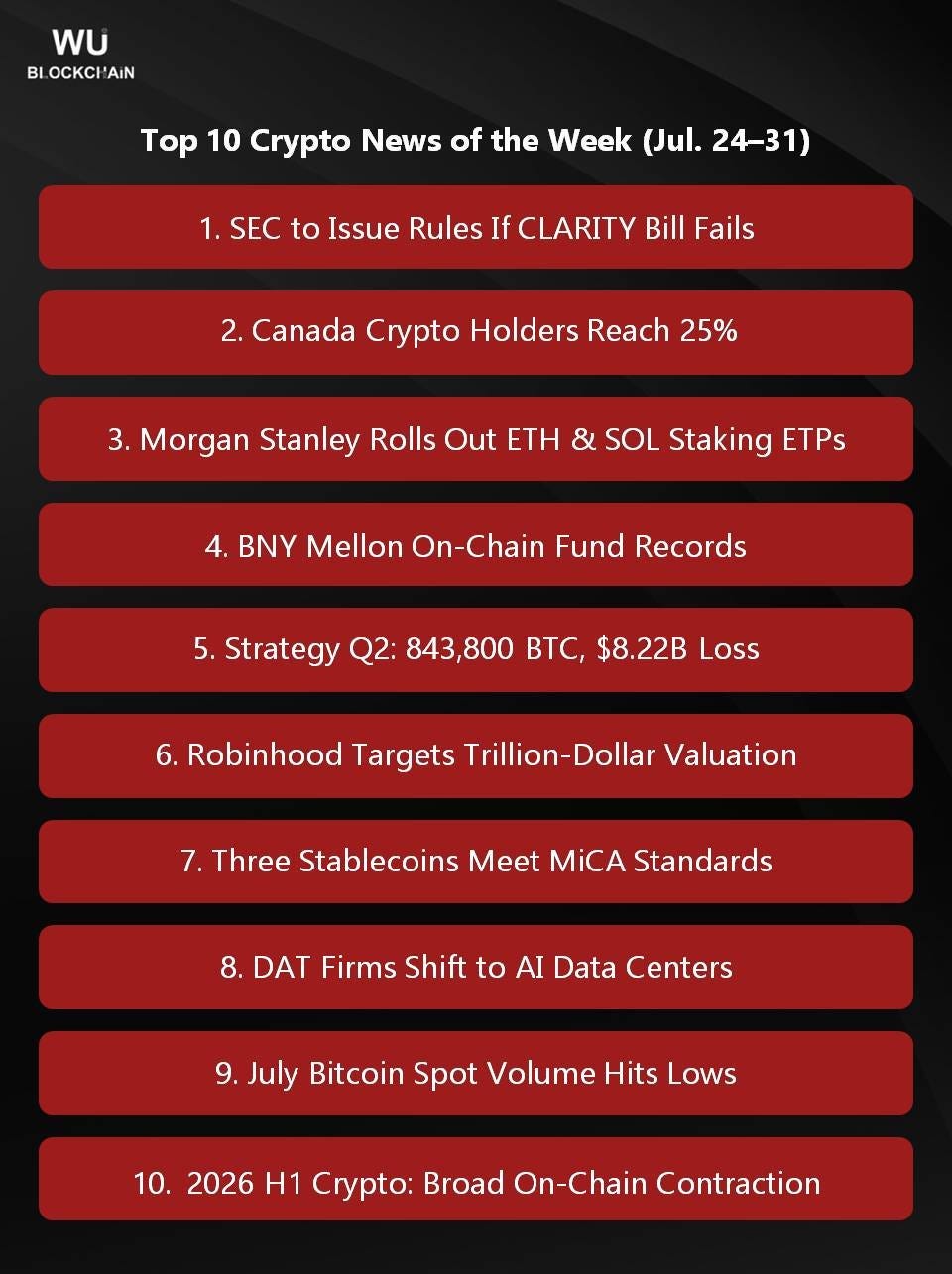
1. If CLARITY Act Stalls, SEC Will Issue Its Own Crypto Market Rules link
Paul Atkins, Chair of the US SEC, stated that if Congress fails to pass the CLARITY Act, the SEC stands ready to craft its own rules governing crypto market structure. However, legislation would offer greater durability and prevent the regulatory framework from shifting with changes in administration. The bill cleared the Senate Banking Committee in May by a 15–9 vote and has yet to advance to a full Senate vote. The SEC has placed rules for crypto asset issuance, custody and trading on its 2026 regulatory agenda.
2. Crypto Ownership in Canada Rises to 25%, Marking Mainstream Financial Adoption link
According to the latest survey report released by the Ontario Securities Commission (OSC), the number of cryptocurrency holders in Canada has more than doubled over the past few years. Currently, one quarter (25%) of Canadians own digital assets or crypto investment funds, up from 10% in 2023 and 13% in 2022. The survey also shows that cryptocurrency use is moving beyond pure speculation. Seventy-four percent of existing crypto owners report having actually used digital assets, while 89% of stablecoin holders have utilized their positions, with 20% employing them for international transfers. Additionally, investor awareness of due diligence has improved: 50% of crypto holders verify whether trading platforms are legally registered before investing, compared with 38% in prior surveys.
3. Morgan Stanley Investment Management Launches ETH and Solana Spot ETPs With Staking Plans link
Morgan Stanley Investment Management, the asset management arm of Morgan Stanley, has launched the Ethereum spot ETP MSSE and Solana spot ETP MSOL, listed on NYSE Arca, both with an expense ratio of 0.14%. The two products plan to stake portions of ETH and SOL, and Morgan Stanley Investment Management will not retain staking rewards. Together with the previously launched Bitcoin product MSBT, its crypto ETP lineup now covers BTC, ETH and SOL.
4. BNY Mellon to Launch Digital Transfer Agency Service, Recording Fund Holders on Blockchain link
BNY, with over $59 trillion in assets under custody and administration, will launch a digital transfer agency service that migrates fund transaction processing and shareholder recordkeeping to blockchain while retaining legacy transfer agency systems. BNY’s transfer agency business currently serves approximately $8.6 trillion in assets and 7.6 million accounts. Baillie Gifford will be the first to deploy the system for the UK’s first fully native regulated tokenized fund, and BlackRock plus BNY’s Dreyfus are expected to adopt it in upcoming funds.
5. Strategy Releases Q2 Earnings: 843,800 BTC Held, $8.22 Billion Loss From Fair Value Changes link
Strategy, formerly MicroStrategy, released its Q2 2026 earnings report. As of July 26, the company held approximately 843,775 Bitcoin, representing a 25% increase year-to-date, and raised around $17.06 billion cumulatively via its ATM offering program. Q2 revenue stood at $122.4 million, up 6.9% year-on-year. Driven by fair-value movements of Bitcoin holdings, the firm posted a net loss of $8.22 billion, compared with a net profit of $10.02 billion in the prior-year quarter. At the end of June, it held $1.71 billion in cash and cash equivalents and $736.1 million in short-term investments.
Strategy stated it has lifted its dollar reserves to $3.75 billion, enough to cover preferred dividends and debt interest for roughly 2.1 years. Year-to-date, the company raised about $218.4 million by selling Bitcoin to fund part of preferred dividends and repurchased STRC preferred stock with a notional value of $28.9 million for approximately $25 million. It also noted convertible debt fell from $8.21 billion to $6.71 billion at quarter-end.
On the Q2 earnings call, Strategy said future capital raises will no longer be fully deployed into Bitcoin; instead, it will dynamically allocate between BTC and dollar reserves based on market conditions to strengthen the stability of its Digital Credit framework. The company reiterated it may sell small amounts of Bitcoin when conditions are favorable to boost dollar reserves, cover preferred dividends and interest, and support share repurchases. It also clarified no current plans to pursue Bitcoin-backed loans, citing counterparty risk, margin risk and vulnerability to short selling. Management aims to gradually reduce convertible debt and maintain dollar reserves at a level covering roughly two to three years of dividends and interest.

Sponsored by FinTax
6. Robinhood CEO: Firm on Track to Become First Trillion-Dollar Financial Enterprise link
Robinhood CEO Vlad Tenev said on the Q2 earnings call that the company aims to become the first financial firm to reach a $1 trillion valuation, and will continue expanding around Agentic Finance, Robinhood Chain, global asset tokenization and private markets. Robinhood CFO Shiv Verma stated the firm believes its business can grow tenfold over the next decade.
The company has rolled out perpetual futures overseas and plans to make the product available to more customers. On a U.S. launch timeline, it offered no specific date but emphasized that “the absence of a timeline should not be taken as a lack of active pursuit.” Tenev also disclosed that the team is actively building AI Agentic Trading capabilities and intends to open more AI tools to traders in suitable scenarios.
Robinhood’s Q2 2026 net revenue rose 32% year-on-year to $1.308 billion, a record high. Net income grew 48% to $573 million, with diluted EPS of $0.62. Transaction-based revenue climbed 44% to $776 million: prediction markets revenue surged more than tenfold to $156 million, options revenue rose 29%, equities revenue jumped 95%, while crypto revenue fell 38% to $100 million. Quarterly net deposits reached $21.7 billion, platform assets grew 32% year-on-year to $369 billion, and Robinhood Gold subscribers rose to 4.8 million. The company also lowered its 2026 guidance for adjusted operating expenses and share-based compensation to a range of $2.675 billion to $2.775 billion.
7. Among Top 50 Stablecoins by Market Cap, Only USDC, USDG and EURC Meet MiCA Requirements link
Patrick Hansen, Senior Director of EU Strategy and Policy at Circle, wrote that 21 issuers in the EU have launched roughly 35 regulated e-money tokens. Yet among the world’s top 50 stablecoins by market capitalization, only USDC, USDG and EURC comply with MiCA rules. He argued that subsequent MiCA reviews should boost the regime’s competitiveness and strengthen global regulatory coordination. The framework should support EU-based e-money tokens in expanding cross-border payments and tokenized trade, while establishing an acknowledgment mechanism for non-EU regulated stablecoins to bring more global stablecoin activity under MiCA oversight.
8. Multiple DAT Firms Announce Shift to AI Data Center Businesses in Recent Months link
Amid the prolonged crypto slump, at least a dozen Digital Asset Treasury (DAT) firms have pivoted toward AI data centers and similar businesses in recent months to win back investors, with limited results so far. K Wave Media’s stock has fallen roughly 71% since shifting to data center development in May; Lixte Biotechnology dropped around 33% after merging with a battery firm; AlphaTON Capital, rebranded Alpha Compute, also declined about 33%. Multiple law firms note the DAT hype has cooled markedly, and more companies are pursuing new lines including AI, data centers, aerospace and small modular nuclear reactors.
9. July Average Monthly Bitcoin Spot Volume May Hit Lowest Level Since November 2023 link
K33 Research stated that Bitcoin markets remained sluggish in July and are on track for the lowest average monthly spot trading volume since November 2023. The report noted BTC fell around 3% over the past week, oscillating within the $60,000–$66,000 range. CME Bitcoin futures open interest sits at multi-year lows, while perpetual open interest stands at approximately 300,000 BTC. Average daily spot turnover in July was roughly $2.2 billion, reflecting persistently weak market participation.
10. Crypto Market Sees Broad On-Chain Contraction Instead of Sector Rotation in H1 2026 link
Binance Research’s H1 2026 on-chain market report states that the crypto space saw broad-based on-chain contraction rather than sector rotation in the first half of the year. Global DeFi TVL fell by $43.4 billion, a 38% drop, while the combined market capitalization of six major L1s shrank by $246.5 billion, down 42%. Key highlights include: marginal Ethereum holders shifted from ETFs to corporate balance sheets; spot ETF holdings declined to 5.2 million ETH, whereas digital asset treasury firms increased their holdings to 7.7 million ETH. Activity on general-purpose L2s deteriorated sharply, with user operations falling roughly 77% from January to June. Solana network revenue dropped 64.5%. BNB Chain emerged as a leading hub for tokenized equities and stood as the only deflationary major L1 with an annualized burn rate of 5.05%. The industry recorded 207 security incidents in H1 with losses totaling $972 million. Driven by the World Cup and non-sports events, monthly notional volume in prediction markets surged 86% to $51.6 billion; Kalshi and Polymarket accounted for 92% of total June trading volume.
Fundraising
Ethereum Institutional closed its first ecosystem funding round led by BitMine, SharpLink and others. link
AI security firm V12 secured a $10 million seed round to build an automated vulnerability discovery system. link
Robotics data platform Axis Robotics completed a $12 million seed financing. link
Distributed AI infrastructure project ALPHEA announced $5 million in funding. link
Learn more, check out crypto-fundraising.info.
Follow us
Twitter: https://twitter.com/WuBlockchain
Telegram: https://t.me/wublockchainenglish