
WuBlockchain Weekly: Strategy Conducts First Large-Scale BTC Disposal, Swift Pilots Tokenized Cross-border Payments and Russia's Largest Bank to Launch Crypto Wallet, etc


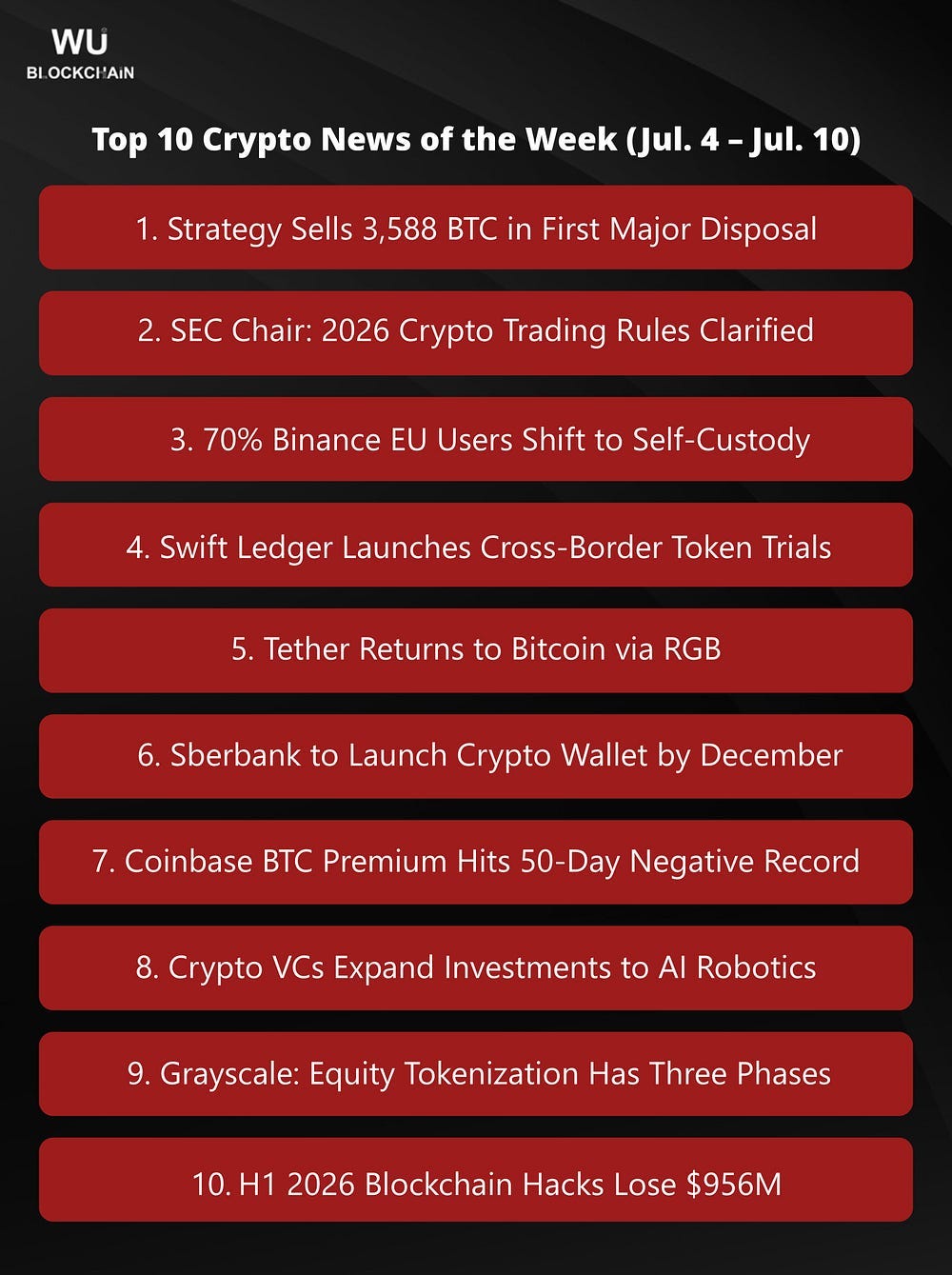
1. Strategy Sells 3,588 BTC in Its First Large-Scale Bitcoin Disposal link
Strategy announced it had offloaded 3,588 BTC for USD 216 million to cover dividends on its digital credit securities. As of July 6, 2026, Strategy’s Bitcoin reserves stood at 843,775 BTC alongside USD 2.55 billion in cash reserves. Saylor added that the proceeds covered Q2 dividends for STRF, STRE, STRK and STRD, plus the full monthly June dividend for STRC. This marked the company’s first large-scale Bitcoin disposal, following a symbolic sale of just 32 BTC previously.
Separately, Michael Saylor, founder of Strategy, posted to explain the core MSTR metric dubbed Bitcoin Breakeven ARR. He noted the indicator is widely misinterpreted by the market. Its core logic holds that if Bitcoin’s long-term annualized appreciation outpaces 3.3%, capital gains from the BTC holdings can sustain STRC dividend payouts indefinitely. Charts shared by Saylor showed that even with zero annual BTC price growth, Strategy still has a 31-year runway of funds allocated for dividends.
JPMorgan outlined its latest research report, arguing that while Strategy’s BTC selling strategy may create periodic downward selling pressure, it does not constitute a major structural headwind for Bitcoin. The genuine systemic risk stems from the shifting trajectory of blockchain adoption in finance: industry applications are increasingly migrating away from public blockchains toward permissioned ledger infrastructure. Analysts warned that if tokenization, payments and settlement workflows shift largely within traditional financial closed networks, the broader crypto sector risks structural downgrades — featuring diminished activity, liquidity and capital inflows that would in turn weigh on Bitcoin’s outlook. The report explained institutional demand favors permissioned blockchains for superior privacy controls, robust KYC/AML frameworks, clear governance rules, defined legal liability and consistent regulatory clarity, creating competitive pressure for public chains such as Ethereum.
2. SEC Chair: 2026 Agenda to Clarify Rules for Crypto Financing & On-Chain Trading of Tokenized Securities link
Paul Atkins, Chair of the SEC, issued a statement regarding the 2026 regulatory agenda, stating that the SEC will encourage more crypto-related products to return to the United States, formulate clear rules for crypto asset financing, and clarify market participants’ standards for custody as well as facilitate on-chain trading of tokenized securities. The SEC’s 2026 regulatory agenda shows that the SEC has included at least three crypto-related proposed rules on its agenda, including Crypto Assets, amendments to financial responsibility and recordkeeping rules for broker-dealers engaging in crypto asset businesses, and Crypto Market Structure Amendments. These relevant rules will cover the issuance and sale of crypto assets, potential exemptions and safe harbors, the application of broker-dealer regulations, and the trading of crypto assets on ATSs and national securities exchanges.
The U.S. Securities and Exchange Commission (SEC) has updated its 2026 agenda and plans to release the long-awaited draft cryptocurrency regulatory rules for public comment as early as this month. The proposal aims to establish an industry-wide safe harbor mechanism, offering broad exemptions and regulatory safeguards for specific on-chain financial activities such as tokenized securities and DeFi, ensuring relevant participants are not easily subject to regulatory enforcement actions. In addition, a recent ruling by the U.S. Supreme Court affirmed that Trump has the authority to remove regulatory agency commissioners at will, a move that further expands the President’s oversight authority over key regulatory sectors including crypto assets.
3. Post-MiCA Implementation, Around 70% of Binance EU Users Withdraw Assets to Self-Custody Wallets link
Binance CEO Richard Teng stated that after Binance suspended partial EU services, around 70% of European users withdrew their funds to self-custody wallets, with only roughly 30% transferring assets to other MiCA-compliant platforms. Data shows Binance recorded approximately $1.23 billion in net outflows for the week ending June 29. Teng said this trend may undermine the consumer protection objectives originally intended by MiCA.
Previously, Binance halted trading services for several European countries including France starting July 1 due to failure to secure MiCA licenses in a timely manner. Binance once served around 2 million users in France and has emailed local users to reassure them their funds remain safe, while advising them to transfer crypto assets to MiCA-licensed platforms or self-custody cold wallets. French users can currently only withdraw assets and are barred from spot, leveraged and other trades. The report quoted the compliance head of France’s licensed trading platform Coinhouse, noting that despite sizable withdrawals from Binance recently, mass user exodus has not yet materialized. On-chain data indicates Binance saw about $1.6 billion in net outflows over the past month, yet the platform still manages roughly $114 billion worth of crypto assets.
4. SWIFT Blockchain Ledger Enters Initial Operational Phase; 17 Banks to Pilot Tokenized Cross-Border Payments link
Swift announced that its blockchain-based ledger is now available for initial use, enabling financial institutions to conduct round-the-clock cross-border payments via tokenized deposits. Seventeen banks across six continents are preparing to pilot real-time transactions, including ANZ, BNP Paribas, BNY Mellon, Citi, DBS, HSBC, Standard Chartered, UBS and Wells Fargo. Swift stated that the shared ledger delivers a secure orchestration layer for bank-issued tokenized deposits and final settlement through existing systems to boost global liquidity efficiency, with future support for innovations such as programmable money and agent commerce.
5. Tether Plans Re-Entry to Bitcoin Ecosystem via RGB Protocol link
Tether plans to natively issue USDT on Bitcoin via RGB Protocol v0.11.1, with UTEXO driving commercial implementation. This means USDT will return to the Bitcoin network where it was first launched through Omni-Mastercoin back in 2014. RGB allows users to send and receive USDT between Bitcoin addresses and compatible wallets. UTEXO stated the relevant features are expected to launch as early as July, with wallets including Tether Wallet and multiple exchanges rolling out support sequentially.

Sponsored by FinTax
6. Sberbank, Russia’s Largest Lender, to Launch Crypto Wallet & Digital Custody Services Before December link
Sberbank, Russia’s largest bank, plans to launch crypto wallet and digital custody services before December following the passage of relevant digital asset legislation, which will be integrated into its Sberbank Online and SberInvestments platforms. The bill, set to take effect on September 1, will establish a licensing framework for crypto trading, custody, fiat conversion and cross-border settlements. Sberbank stated that the new wallet will allow customers to access authorized cryptocurrencies within the bank’s proprietary applications.
7. Coinbase Bitcoin Premium Index Stays Negative for 50 Consecutive Days, Setting All-Time Record link
Coinbase Bitcoin Premium Index has remained in negative premium territory for 50 consecutive days since May 19, with the latest reading at -0.0742%, hitting the longest streak of negative premiums since the indicator’s launch. Previously, the index logged 40 straight days of negative premiums from January 16 to February 24 this year, surpassing the roughly 30-day negative stretch during the “1011 crash”. Historical data shows prolonged negative premiums typically coincide with outflows of institutional capital in the United States or signal near-term corrective pressure in the market.
8. Crypto VC Funds Expand Investment Scope to AI, Robotics and Other Tech Verticals link
As sectors including AI, robotics and prediction markets draw increasing capital, crypto venture capital funds are gradually broadening their investment scope. Paradigm’s newly raised $1.2 billion fund will invest in cutting-edge technologies such as AI and robotics alongside crypto, while newly raised funds from Framework Ventures and Haun Ventures also cover verticals including AI, robotics, energy and Agents. Galaxy Research data shows crypto venture capital investment reached approximately $4 billion in Q1 2026, down roughly 50% quarter-on-quarter, with the number of newly launched funds hitting its lowest level since Q3 2020. Meanwhile, Crunchbase figures indicate AI startups captured around 70% of global venture capital funding in Q2. Industry insiders argue that as the crypto sector integrates deeper into traditional finance, the competitive edge of crypto-dedicated investment vehicles is fading.
9. Grayscale: Global Equity Tokenization Accelerates, Evolving in Three Distinct Phases link
Zach Pandl, Head of Research at Grayscale, released a report stating that the tokenization of global equity markets has commenced, bringing benefits such as round-the-clock trading to users. He categorized the evolution of equity tokenization into three phases. The first phase is the third-party wrapping model, which currently accounts for over 70% of market value and operates mainly on blockchains including Ethereum and Solana. The second phase is the entitlement model represented by DTCC pilots, leveraging regulated post-trade infrastructure. The third phase, holding the greatest long-term potential, is the issuer-originated model where companies issue securities natively on-chain. Securitize became the first NYSE-listed firm to accomplish this last week. Grayscale expects the three models to coexist for years to come.
10. 182 Blockchain Security Incidents Recorded in H1 2026, Resulting in Approximately $956M in Losses link
SlowMist released the Mid-Year 2026 Blockchain Security and Anti-Money Laundering (AML) Report. The report recorded 182 blockchain security incidents in the first half of 2026, with total losses reaching approximately $956 million, compared with 121 incidents and losses of around $2.373 billion in the same period of 2025. Broken down by ecosystem, Ethereum suffered losses of about $134 million, BSC around $36.35 million, and Arbitrum roughly $4.93 million. By project category, there were 116 DeFi incidents resulting in losses of nearly $490 million, alongside 20 cross-chain bridge incidents with total losses of $346 million, among which the single Kelp DAO incident accounted for $292 million. SlowMist stated that AI-enabled scams, supply chain attacks and vulnerabilities in cross-chain infrastructure are expanding the attack surface, and actual losses could be even higher due to unreported incidents and unaccounted-for retail user losses.
Fundraising
Circle Ventures invests in digital asset intelligence firm Elliptic link
Tether will invest $20 million in Brazilian crypto platform Mercado Bitcoin link
Morpho secures $175 million financing led by Paradigm and a16z link
KOR Protocol closes $7.5 million Series A financing at a $100 million valuation link
Decentralized AI protocol Prime Intellect announces $130 million Series A financing link
Gauntlet secures $125 million financing led by SBI Holdings link
U.S. institutional crypto trading platform EDX Markets completes $76 million Series C financing led by SBI Holdings link
M1X Global raises $5.5 million seed round led by Paradigm link
QIZ Security closes $17 million seed financing link
Learn more, check out crypto-fundraising.info.
Follow us
Twitter: https://twitter.com/WuBlockchain
Telegram: https://t.me/wublockchainenglish