
WuBlockchain Weekly: STRC Preferred Stock Sharply Deviates, New Fed Chair Debuts and Ethereum Nears Scaling Upgrade, etc


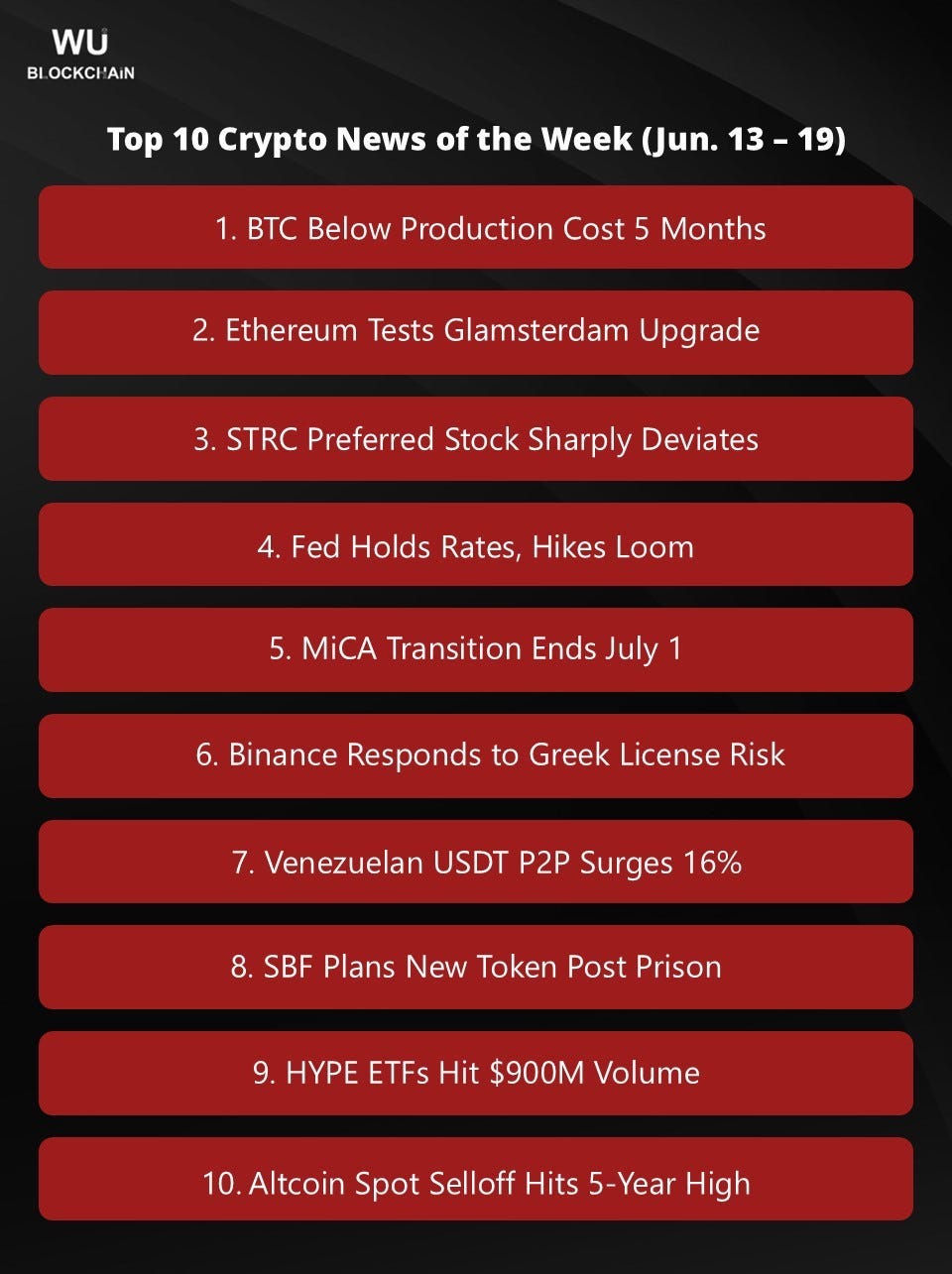
1. Bitcoin Trades Below Production Cost for 5 Straight Months; 20% Miners Run at Loss link
JPMorgan stated that the economics of Bitcoin mining have continued to deteriorate since 2026. Bitcoin prices have remained below its estimated production cost of approximately $78,000 for five consecutive months, with roughly 20% of miners currently operating at a loss. The report noted that miners are becoming more sensitive to price fluctuations. When prices fall below production costs, high-cost miners shut down their rigs, driving down the network’s total hash rate and mining difficulty. Burdened by operational pressures, listed mining firms sold over 32,000 BTC in aggregate during the first quarter of 2026 to cover operating expenses, exceeding their total sales volume for the entire year of 2025. JPMorgan projected that volatility in hash rate and mining difficulty will remain frequent and substantial as long as Bitcoin prices stay under production costs.
2. Ethereum Glamsterdam Upgrade Enters Final Devnet Testing, Mainnet Launch Slated for H2 link
Ethereum core developers have entered the final sprint phase for the next major network upgrade “Glamsterdam”. Teams have begun full testing of the fork version containing all planned Ethereum Improvement Proposals (EIPs) on closed developer networks (devnets), marking the last development stage before code freezing and deployment to public testnets. Parithosh Jayanthi, DevOps engineer and core developer at the Ethereum Foundation, stated that while an exact activation timeline has not yet been finalized, tremendous progress has been made and the upgrade is expected to launch officially in the second half of 2026.
Following the Glamsterdam upgrade, Ethereum’s Gas Limit will be drastically raised from the current 60 million to around 200 million. This translates to a more than threefold increase in L1 execution capacity, with an anticipated further doubling shortly thereafter.
3. Michael Saylor States STRC Is AI-Engineered Product; Ticker Slumps to $82.7 Intraday link
In an interview with CoinDesk, Michael Saylor stated that STRC, the “Stretch” variable-rate perpetual preferred stock issued by the company, is a product he developed with AI assistance:
“I designed all of this using AI, you know, I couldn’t have done it on my own. I truly mean it, I leveraged artificial intelligence. I spent hours back and forth discussing this with the AI, just like the rest of us, arguing with it and learning how to design these various instruments, asking it ‘Can I do this?’ ‘Can I structure it that way?’ At a certain point, I said: ‘I want a dividend-priority product that distributes monthly, and I want its price to anchor steadily at 100.’ The AI responded, ‘You can structure it like this, this and this.’ I asked, ‘Has anyone built anything like this before?’ It scanned for ten minutes and told me: ‘No entity has ever created this instrument in human history, yet it is fully compliant and entirely viable.’”
The decoupling of STRC from its $100 par value has drawn sustained attention from the community. The share plunged to an intraday low of $82.7 in early Friday trading and closed at $88.8.
Matt Cole, CEO of Strive, posted on social media that the day marked the most challenging session in Digital Credit’s history. STRC tumbled as low as $82.50 before staging a sharp rebound, while SATA dropped from par to the low $90s and subsequently recovered. He attributed the volatility to leveraged liquidations rather than deterioration in underlying credit quality, explaining that forced sell-offs triggered cascading selling pressure, yet the issuer’s credit fundamentals remained robust. Cole noted Strive’s dividend reserves stayed intact with no financial strain on the firm, and substantial buying interest emerged near the intraday lows for both STRC and SATA, emphasizing that liquidation events are distinct from credit crises.
On May 23, Phong Le, CEO of Strategy, published a post stating that STRC, the company’s tradable preferred stock, had grown from zero to a market capitalization of $10.5 billion within 10 months, making it the world’s largest tradable preferred stock with a valuation more than twice that of the second-largest peer. The attached chart showed Wells Fargo’s preferred stock WFC/PL, the second-ranked instrument, with a market cap of approximately $4.7 billion.
4. Fed Holds Rates Steady; Half Officials Foresee At Least One Hike This Year link
The Federal Open Market Committee (FOMC) voted unanimously 12–0 to keep the target range for the federal funds rate unchanged at 3.50%–3.75%. The statement noted that despite heightened uncertainty stemming from events in the Middle East, U.S. economic activity continues to expand solidly, with robust productivity growth and capital investment. Employment gains have roughly matched labor force expansion, while the unemployment rate has seen little movement.
During the meeting, Warsh adopted a communication style distinct from former Chair Powell’s plain-spoken approach, employing a more politicized tone laced with industry jargon. He frequently referenced “first principles,” “alternative frameworks,” and the Fed’s statutory remit. Warsh disclosed that he was the sole Fed official who declined to submit projections for future borrowing costs in the dot plot, and reaffirmed that the Fed’s core priority going forward is price stability. To address prior market concerns that he might act as a puppet pressured by President Trump to cut rates, Warsh sent an indirect signal by refusing to pre-judge rate paths and offering vague remarks on inflation reduction. Following the press conference, Trump reacted tepidly to the Fed’s decision to hold rates steady yet voiced his support for Warsh.
Nick Timiraos, reporter at The Wall Street Journal, stated that the Fed’s latest dot plot reveals a distinctly hawkish tilt. Nine out of 18 officials expect at least one rate hike this year, six of whom project multiple hikes; only one official forecasts a rate cut in 2026, while another declined to submit a Summary of Economic Projections (SEP). Timiraos also pointed out that the full FOMC statement underwent an almost complete rewrite and was significantly shortened relative to prior editions.
5. EU MiCA Transition Period Ends July 1; 75% Crypto Firms Risk Losing Operating Licenses link
The transition period of the EU Markets in Crypto-Assets Regulation (MiCA) will expire on July 1. Cryptocurrency exchanges, brokerages and wallet service providers without MiCA licenses will no longer be allowed to offer services to EU users starting from that date. Data shows that only 194 crypto firms across the EU held valid licenses as of May 2026, compared with more than 3,000 crypto entities registered for operations back in 2024. Approximately 75 percent of existing firms are projected to lose their operating eligibility. Unlicensed platforms must halt new deposits, guide users to withdraw assets or transfer holdings to licensed service providers. Regulators in some member states will also enforce measures including website blocks and public warning lists.
According to registry data from the European Securities and Markets Authority (ESMA), merely around 200 entities have obtained authorization as Crypto Asset Service Providers (CASPs), a figure far below the market scale prior to MiCA’s rollout. Industry insiders argue that high compliance costs and cumbersome approval procedures are likely to trigger industry consolidation and accelerate merger and acquisition activity across the sector.

Sponsored by FinTax
6. Binance Spokesman Responds to Greece License Rejection Rumors: Regulator Has Not Raised Formal Objections link
Binance is poised to lose the authorization to serve EU clients as its license application filed in Greece is set to be rejected. Binance stated it believes it has satisfied all relevant criteria to obtain MiCA authorization within the EU. The exchange has maintained constructive communications with regulators over the past 18 months and completed the full formal application process with Greek regulators. It holds the view that it meets all MiCA requirements and has learned that the regulator has finished its review and deemed the application compliant, with the Hellenic Capital Market Commission yet to issue any formal objection. The Hellenic Capital Market Commission noted it could not comment on the matter at this stage due to confidentiality rules. If Binance fails to secure the license, it will be unable to operate legally across the EU starting July.
7. Venezuela P2P USDT Surges 16% Over Past 30 Days link
USDT has risen roughly 16% on Venezuela’s local P2P markets over the past 30 days, climbing from around 690 bolívares to an intraday high of more than 800 bolívares. Domestic currency liquidity in Venezuela expanded by about 23.26% over the same period, with a year-to-date increase exceeding 131%. Reports state that rapid expansion of bolívar supply, insufficient US dollar liquidity in banks, and foreign exchange purchase restrictions have pushed enterprises and residents to buy USDT via P2P platforms such as Binance to preserve wealth. As local merchants reference USDT prices for daily pricing, the widening stablecoin premium is passing through to prices of goods and services.
8. SBF Takes Daily Medication for Clinical Depression; Cellmate Claims He May Launch New Token Post-Release link
According to New York Magazine, new details have emerged about Sam Bankman-Fried (SBF), founder of collapsed crypto exchange FTX, who is serving a 25-year sentence at the Federal Correctional Institution Lompoc in California. The 34-year-old takes daily Adderall to manage clinical depression and ADHD, and is writing a serialized prison memoir titled Manfred from his cell.
He has opted for an independent, non-gang status after refusing to abide by the rules of The Woods, the white inmate gang, while continuing to play cards and chess with prisoners from other racial groups including The Black. When his cellmate David Bunevacz asked about his plans post-release, SBF claimed he would need a startup fund of $50 million or $100 million to launch a legitimate large-scale business, and asserted, “I’m gonna start my own coin when I get out, and everyone’s gonna flood to it.” Bunevacz later remarked, “He’s probably joking, and they’re probably not gonna flood to it. But who knows.”
SBF formally filed a petition for a presidential pardon with the Trump administration on June 8 this year. Immediately afterward, the implied odds of him receiving clemency on prediction market Polymarket doubled to 14%.
9. First Batch of Spot HYPE ETFs Hit $900M Cumulative Volume, $153M Net Inflows in One Month link
Roughly one month after the debut of the first spot HYPE ETFs, their cumulative trading volume has neared $900 million, with aggregate net inflows standing at around $153 million. Three products are currently available in the market: THYP from 21Shares, BHYP from Bitwise, and HYPG from Grayscale. All three hold HYPE directly and distribute staking yields to investors. Data shows the current annualized staking yield of HYPE is approximately 2.25%, with 434 million HYPE tokens staked, accounting for roughly 45% of the total stakable supply. BHYP and THYP generate the bulk of trading activity, while HYPG, launched later, remains in the capital accumulation phase.
Binance founder CZ commented on Hyperliquid during the Galaxy Brains podcast, stating, “I think Hyperliquid’s innovation is actually awesome.” CZ said Hyperliquid occupies a niche market that Binance cannot easily compete in, as it requires no KYC and brands itself a decentralized platform. At the same time, CZ noted he would not adopt Hyperliquid’s current operational model given his past experience, adding, “I guess they have a very good legal team.”
10. Altcoin Spot Selling Pressure Hits Five-Year Extreme Level link
According to IT Tech, an analyst at CryptoQuant, selling pressure on altcoins on spot exchanges has hit an extreme five-year high, with the spot market logging net outflows for 15 consecutive months. The cumulative buy-sell volume differential for altcoins excluding BTC and ETH has slumped to its deepest negative reading since data tracking began in 2020. The indicator hovered near neutral levels in early 2025 before swinging sharply negative and trending downward ever since.
Data from Binance Research shows that massive TVL contraction stemming from roughly $13 billion in capital outflows triggered by DeFi exploits in April has passively pushed the on-chain leverage ratio to approximately 38%, matching levels last seen in 2021. The uptick in the ratio does not reflect a genuine recovery in borrowing demand, and no meaningful deleveraging has materialized despite the recent market pullback.。
Fundraising
Galaxy Ventures co-led Karta’s $140 million Series A financing round. link
Instant payments platform Interchecks announced the completion of a $50 million Series C financing round. link
EarnOS closed a $6 million Pre-A round led by 1kx. link
Latin American cross-border payments app El Dorado secured $9 million Series A financing with Paradigm as the lead investor. link
APEC, a perpetual futures exchange founded by the son of U.S. Senator Gillibrand, raised $30 million in funding. link
Renaiss completed a $1.5 million seed round led by YZi Labs. link
Raised $8.3 million Series A financing co-led by TX Ventures and SixThirty. link
African payment infrastructure firm Flutterwave announced a strategic investment from Ripple. link
Coinbase Ventures made a strategic investment in Multipli via its Base Ecosystem Fund. link
Lite Strategy led a $1 million strategic investment in ZK Innovations to support LitVM’s development of a zero-knowledge Layer 2 network for Litecoin. link
Learn more, check out crypto-fundraising.info.
Follow us
Twitter: https://twitter.com/WuBlockchain
Telegram: https://t.me/wublockchainenglish